Freight Class Calculator (NMFC & Density) Guide
Calculate freight class and NMFC density instantly from pallet dimensions and weight. Estimate LTL shipping class, cubic feet, and bumping rule cost savings.
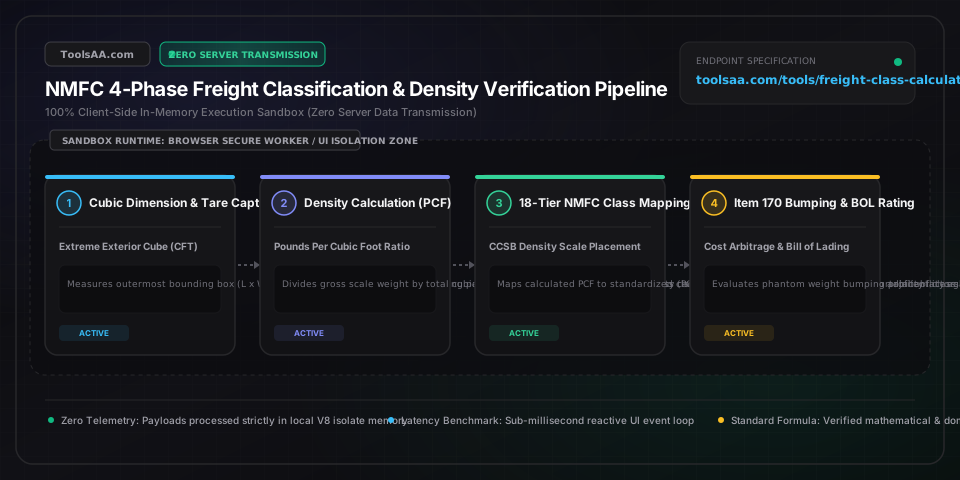
Key Parameters & Controls
Greatest exterior dimensions of the handling unit including pallet base, crating, and cargo overhang. Freight carriers use automated overhead laser dimensioners (CubiScan); any protruding box corner defines the chargeable cube.
Total combined mass of the commodity, packaging, straps, and pallet tare (standard wood GMA pallets add 35-50 lbs). Understating tare weight leads to automatic scale re-weigh penalties and carrier re-invoicing fees.
Total count of individual pallets, skids, drums, or crates. Multiple handling units can be calculated individually or consolidated into a blended total shipment density.
Calculated as total gross weight divided by total volume in cubic feet (CFT = L * W * H / 1728). Primary metric used by the CCSB 18-tier scale to assign freight classes from 50 (over 50 PCF) to 500 (under 1 PCF).
Permissible NMFC provision allowing shippers to declare a higher artificial weight on the original Bill of Lading to reach the next lower freight class breakpoint when the reduced class cwt tariff yields a lower total freight invoice.
Maximum released valuation per pound. Under NMFC rules, lower freight classes carry lower carrier liability limits ($0.10-$5.00/lb), while Class 400-500 goods command liability up to $25.00/lb or higher freight surcharges.
Pro Tips & Best Practices
Never measure only the commodity cartons while ignoring the wooden pallet or shrink-wrap bulge. Carrier automated dimensioners (CubiScan and static infrared gantries) measure the maximum bounding box. A 1-inch box overhang on a 48x40 inch pallet expands the calculated footprint to 50x42 inches, adding 1.74 cubic feet per 48-inch height, artificially lowering your calculated density and bumping your shipment into a higher, more expensive freight class.
To legally benefit from the Bumping Rule (paying for phantom weight to qualify for a lower freight class), the bumped weight and the lower freight class MUST be explicitly annotated on the original Bill of Lading at the time of carrier tender. Once the carrier picks up the freight, you cannot retroactively bump weight on an invoice correction or freight dispute.
Most major LTL carriers (Old Dominion, Estes, Saia, XPO) enforce an aggressive Cubic Capacity Rule: shipments occupying 750 cubic feet or more with an average density of less than 6 PCF are automatically stripped of discounted tariff rates and re-rated at a minimum default density of 6 PCF or billed at full truckload / exclusive-use rates, resulting in invoice shocks of $800 to $2,500.
If your pallet has a peaked or rounded pyramid top that prevents the carrier from double-stacking other freight above it, carriers will bill the height of the shipment to the full trailer ceiling (96 to 108 inches) regardless of actual cargo height. Always design flat-top packaging or strap rigid tier-sheets to preserve the stackable discount.
Common Gotchas & Troubleshooting
⚠️Carrier Weight & Inspection (W&I) Reclassification Fee Incurred
When a carrier scale or laser inspection finds a discrepancy between the BOL class and their measured density, they assess a $25 to $75 inspection fee plus the rate difference. Prevent this by pre-calibrating pallet tare weight (adding 40-50 lbs for GMA wood pallets) and rounding dimensions up to the nearest integer inch.
⚠️Multi-Piece Consignment Rated at the Highest Commodity Class
If you ship multiple distinct commodities on one pallet or shipment without itemizing the individual weights and descriptions on the BOL, NMFC rules mandate that the entire shipment is rated at the single highest freight class among the commodities. Always itemize line items or pre-consolidate them under an approved composite multi-piece density rule.
⚠️Shipment Billed at Double-Cubic Rate Due to 8-Foot Overlength
Handling units with any single horizontal dimension exceeding 96 inches trigger linear overlength accessorials (ranging from $85 to over $350). Reconfigure pallet layout to pack long items diagonally or split into standard 48-inch modules when feasible.
⚠️Bumping Rule Calculation Rejected by Carrier Auditor
The NMFC Item 170 bumping rule is only valid for commodities whose specific NMFC item tariff includes a density-sub-provision authorizing bumping. Verify that your commodity uses a density-based classification (such as plastic articles, furniture, or machinery) rather than a fixed non-density-based NMFC commodity code.
Frequently Asked Questions
How to calculate freight class density formula?▼
Freight density is calculated in two steps: first, multiply length, width, and height in inches and divide by 1,728 to find volume in cubic feet (Cubic Feet = L * W * H / 1,728). Second, divide total gross shipment weight in pounds (including pallet tare) by the cubic feet (Density = Weight / Cubic Feet). Match the resulting pounds per cubic foot (PCF) to the standard 18-tier NMFC table, where greater than 50 PCF is Class 50 and less than 1 PCF is Class 500.
What are the 18 NMFC freight classes and density ranges?▼
The 18 official NMFC classes and their minimum density thresholds are: Class 50 (>50 PCF), Class 55 (35-50 PCF), Class 60 (30-35 PCF), Class 65 (22.5-30 PCF), Class 70 (15-22.5 PCF), Class 77.5 (13.5-15 PCF), Class 85 (12-13.5 PCF), Class 92.5 (10.5-12 PCF), Class 100 (9-10.5 PCF), Class 110 (8-9 PCF), Class 125 (7-8 PCF), Class 150 (6-7 PCF), Class 175 (5-6 PCF), Class 200 (4-5 PCF), Class 250 (3-4 PCF), Class 300 (2-3 PCF), Class 400 (1-2 PCF), and Class 500 (<1 PCF).
How does the NMFC freight bumping rule work to lower shipping costs?▼
Under NMFC Item 170, if your shipment's density is just below a class breakpoint, you can declare an artificial higher weight on the Bill of Lading to qualify for the next lower freight class. Because lower freight classes carry a significantly cheaper base rate per hundredweight (cwt), the reduced rate on the bumped weight often results in a lower total invoice than paying the higher class rate on actual weight.
What is the difference between freight class and NMFC code?▼
An NMFC code is a specific 5-to-6 digit commodity identification number assigned by the NMFTA (e.g., NMFC #155050 for plastic goods), whereas freight class is a standardized shipping tier (50 through 500) determined by density, stowability, handling, and liability. While an NMFC code dictates the specific rules and density sub-provisions for an item, the freight class determines the tariff billing rate charged by LTL carriers.
Why did the carrier reclassify my shipment and charge an inspection fee?▼
Carriers route freight through automated certified scales and overhead dimensioning scanners during terminal cross-docking. If your pallet had packaging overhang, unrecorded pallet tare weight, or rounded edges that expanded the bounding box cube, your recalculated PCF fell into a higher class tier, triggering an automatic invoice re-bill and a $25 to $75 Weight & Inspection (W&I) surcharge.
Related Tools & Utilities
All Tools →Calculate Cash Conversion Cycle (CCC), Days Inventory Outstanding (DIO), Days Sales Outstanding (DSO), and Days Payable Outstanding (DPO). Free trapped working capital with interactive scenario modeling.
Calculate safe withdrawal rates, retirement nest egg, Guyton-Klink guardrails, Trinity Study benchmarks, fee drag, and sequence of returns risk.
Calculate your SaaS Rule of 40 score with revenue growth rate and profit margin. Benchmark against public SaaS multiples, solve target growth, and model FCF.
Professional SaaS Net Revenue Retention (NRR / NDR) and Gross Revenue Retention (GRR) intelligence calculator. Models customer cohort ARR/MRR dynamics including expansion upsells, contraction downgrades, and churn cancellations. Features an ARR movement waterfall bridge, SaaS Quick Ratio efficiency rating, 5-year compounding cohort decay projection, reverse expansion target solver, and sensitivity matrix benchmarked against top-decile BVP and OpenView SaaS standards.
Calculate trench drain channel size, peak storm runoff (Q=CIA), Manning flow capacity, and outlet pipe diameter with imperial and metric engineering precision.
Interactive Roof Pitch Multiplier & Rafter Slope Factor Calculator with real-time client-side analysis and visualization.