NPSHa Calculator & Pump Suction Head

NPSHa Calculator & Pump Suction HeadFT

Calculate NPSHa (net positive suction head available) and pump cavitation margin instantly. Evaluate suction head, vapor pressure, and friction loss across units.

Lbl regime label
Lbl presets ribbon

Title suction config deck

US Customary
Lbl barometric p14.70 psia
34.03ft
Lbl direct atmosphere
Lbl specific gravity0.996
Lbl vapor head short1.38 ft
ft
Desc npshr help
Lbl target standard 1.15x
Kpi npsha
36.36ft
Lbl absolute suction head
Kpi npshr
14.00ft
Lbl pump manufacturer rating
Kpi margin
+22.36ft
Lbl cushion above cavitation
Kpi ratio
2.60x
Lbl standard target 1.15x

Title hydraulic cockpit stage

Verdict safe
Svg impeller datumSvg liquid surface (+6.5 ft)1 atm (14.7 psia)Svg suction nozzleSvg npshr label = 14.0 ftSvg hgl labelSvg vapor pressure line = 1.38 ft
2.60x
Lbl acoustic risk headerDesc acoustic safe
Title engineering guidanceANSI/HI 9.6.1-2017

Text guidance safe

Lbl thermal head margin109.4 °FDesc thermal cushion
Lbl static lift limit15.86 ftDesc static lift limit
Lbl atmospheric head eq34.03 ftDesc atmosphere head eq

Client-Side Processing

High-performance calculation executed entirely in browser memory.

Zero Server Upload Privacy

All payloads remain strictly local with zero external server communication.

Production Ready Export

Clean, optimized output formats ready for immediate deployment.
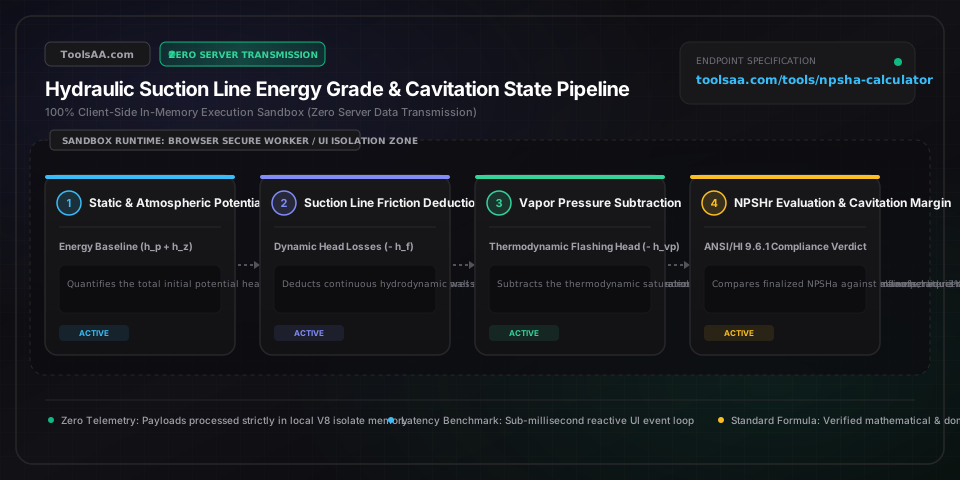
Technical Reference & Architecture Guide

NPSHa Calculator & Pump Suction Head Guide

Calculate NPSHa (net positive suction head available) and pump cavitation margin instantly. Evaluate suction head, vapor pressure, and friction loss across units.

NPSHa Calculator & Pump Suction Head Guide — Client-Side In-Memory Architecture & Data Flow

Key Parameters & Controls

Absolute Surface Pressure Head (h_p)Decimal Head (ft / m)

Absolute pressure exerted on the liquid surface in the suction reservoir converted into equivalent liquid column height (P_abs / (rho * g)). In open tanks at sea level, atmospheric pressure yields approximately 33.9 ft (10.33 m) of water head; in closed vacuum columns, this term shrinks dramatically.

Default: 33.9 ft (10.33 m)
Static Elevation Head (h_z)Signed Decimal Elevation (ft / m)

Vertical geometric distance between the free liquid surface and the pump suction impeller centerline. Evaluated as positive (+) for flooded suction where liquid gravity assists flow, and negative (-) for suction lift installations where pump operates above liquid level.

Default: +6.0 ft (+1.83 m)
Suction Piping Friction Loss (h_f)Decimal Head Loss (ft / m)

Total hydraulic head consumed by fluid shear along the pipe inner wall plus minor friction losses through foot valves, strainers, elbows, reducers, and isolation valves, quantified via the Darcy-Weisbach formulation.

Default: 2.5 ft (0.76 m)
Liquid Vapor Pressure Head (h_vp)Decimal Head (ft / m)

Thermodynamic vapor pressure of the pumped liquid at operating temperature converted into head of liquid (P_vp / (rho * g)). Increases exponentially with temperature; water at 212 deg F (100 deg C) has a vapor head of 33.9 ft (10.33 m), neutralizing all atmospheric pressure assistance.

Default: 0.59 ft (0.18 m) @ 68°F
Net Positive Suction Head Required (NPSHr)Decimal Head Threshold (ft / m)

Minimum total suction head required at the pump suction nozzle to limit cavitation-induced total head loss to 3% (known internationally as NPSH3), certified by the pump manufacturer during hydraulic dynamometer testing.

Default: 10.0 ft (3.05 m)
Cavitation Safety Margin RatioDimensionless Multiplier

Ratio of available head to manufacturer required head (NPSHa / NPSHr). ANSI/HI 9.6.1 mandates a baseline minimum of 1.1x to 1.3x for non-critical municipal water, and 1.5x to 2.5x for boiler feed pumps, hydrocarbons, and high-energy suction impellers to suppress acoustic cavitation damage.

Default: 1.35x

Pro Tips & Best Practices

The Saturated Closed Vessel Equilibrium Paradox

In closed deaerators, flash tanks, and boiling liquid distillation receivers, the vapor space above the liquid is in thermodynamic phase equilibrium with the liquid itself (P_surface = P_vp). Consequently, surface head (h_p) and vapor pressure head (h_vp) exactly cancel each other out: h_p - h_vp = 0. In these critical systems, NPSHa depends entirely on static elevation head minus friction losses (NPSHa = h_z - h_f). Never place a deaerator pump at floor level expecting vessel pressure to assist suction.

The Suction Velocity Head Gauge Discrepancy

When measuring suction pressure with a physical pressure gauge tapped into the suction pipe, the gauge only registers static pressure, omitting the dynamic velocity head (v^2 / (2 * g)). To obtain true NPSHa from field gauge readings, you must add the velocity head: NPSHa = h_gauge + h_atm - h_vp + (v^2 / (2 * g)) + Z_gauge. Neglecting velocity head in high-flow suction lines (e.g. 10 ft/s or 3 m/s) underestimates available head by over 1.5 ft (0.46 m).

Barometric Altitude Decay Penalty

Atmospheric pressure decreases by approximately 0.5 psia per 1,000 feet of elevation (or 1.2 kPa per 100 meters). An open-basin pump operating successfully at sea level will lose 4.0 feet (1.22 m) of NPSHa if relocated to an altitude of 3,500 feet (1,067 m) without changing any piping, which frequently triggers violent cavitation during summer heat waves.

Strainer Clogging Dirt Margin

Clean Y-strainers or basket strainers typically contribute only 0.5 to 1.0 ft of head loss. However, as debris accumulates during continuous operation, the differential pressure across the strainer mesh can surge past 10 to 15 ft of head, causing NPSHa to collapse below NPSHr without any change in tank level. Always design with at least a 3.0 ft dirty-strainer allowance.

Common Gotchas & Troubleshooting

⚠️Pumping unit emits loud rattling noise resembling pumping gravel or marbles accompanied by fluctuating discharge pressure

Classic signature of vaporous cavitation bubble collapse against impeller vanes. Verify if NPSHa has fallen below NPSHr. Immediate mitigation: throttle the discharge control valve to shift the pump operating point leftward to a lower flow rate where NPSHr is significantly smaller, or raise the suction liquid level.

⚠️NPSHa is calculated as positive and exceeds NPSHr by 3 ft, yet the pump still suffers severe impeller pitting and seal failure

NPSHr from pump curves represents NPSH3 (3% total head loss where cavitation is already vigorously underway). High suction energy pumps (suction specific speed S > 11,000) experience incipient cavitation damage at 1.5x to 2.0x NPSHr. Redesign suction line to increase pipe diameter by one nominal size (reducing friction by over 60%) or lower fluid operating temperature.

⚠️Pump loses prime or chatters intermittently despite ample calculated static elevation head in an open basin

Free-surface suction vortexing is entraining atmospheric air into the suction nozzle. Even 1% entrained air by volume reduces centrifugal pump head by up to 15%, while 4% air causes complete air binding. Ensure minimum submergence depth (S_min = D + 0.574 * Q / D^1.5) or install anti-vortex baffle plates over the pipe inlet.

⚠️NPSHa collapses sharply whenever fluid temperature rises by just 10 deg F (5.5 deg C)

Thermodynamic vapor pressure is governed by the Clausius-Clapeyron exponential relation. Near water's boiling point, a slight temperature rise causes a disproportionate jump in vapor pressure head (e.g. from 180°F to 195°F vapor head increases by 9.3 ft). Install a suction line heat exchanger or subcooler to depress liquid temperature below saturation.

Frequently Asked Questions

How do you calculate NPSHa for a centrifugal pump?▼

NPSHa is calculated using the formula NPSHa = h_p +/- h_z - h_f - h_vp, where h_p is the absolute pressure head at the liquid surface (atmospheric or vessel pressure divided by fluid specific weight rho * g), h_z is the static liquid elevation relative to the pump impeller centerline (positive for flooded suction, negative for suction lift), h_f is the cumulative suction piping and fitting friction loss, and h_vp is the liquid vapor pressure head at operating temperature. All values must be expressed in consistent units of absolute liquid head (feet or meters).

What is a good NPSH safety margin over NPSHr?▼

According to the Hydraulic Institute standard ANSI/HI 9.6.1, a safe NPSH margin ratio (NPSHa / NPSHr) typically ranges between 1.1x and 2.5x, or a minimum net differential of 2.0 to 5.0 ft (0.6 to 1.5 m) across the operating range. Clean water services with low suction energy require a minimum margin of 1.1x to 1.2x. Critical services including boiler feed pumps, cryogenic fluids, and continuous hydrocarbon refining units require a margin ratio of 1.5x to 2.0x+ to suppress incipient cavitation erosion and prevent high-frequency mechanical seal vibration.

What is the difference between NPSHa and NPSHr?▼

NPSHa (Net Positive Suction Head Available) is a characteristic of the piping and vessel system leading to the pump suction nozzle, dictated by tank elevation, surface pressure, liquid temperature, and line friction. NPSHr (Net Positive Suction Head Required) is an intrinsic hydraulic property of the pump impeller design, established by the pump manufacturer through standardized dynamometer testing that marks the threshold where cavitation drops total head by 3%. For reliable pump operation without cavitation, NPSHa must always exceed NPSHr with an adequate safety margin.

How do fluid temperature and altitude affect NPSH available?▼

Fluid temperature increases vapor pressure exponentially according to Antoine's equation, directly subtracting from available head (at 212°F / 100°C water vapor head reaches 33.9 ft / 10.33 m, completely offsetting atmospheric head). Altitude reduces ambient barometric pressure by approximately 0.5 psia per 1,000 ft (1.2 kPa per 100 m) of elevation, lowering atmospheric surface head h_p from 33.9 ft at sea level to 27.6 ft at 5,000 ft (8.4 m at 1,524 m). Both factors diminish NPSHa and can easily push an otherwise safe pump into catastrophic cavitation.

Related Tools & Utilities

All Tools →