Wood Fence Materials & Cost Calculator
Tagline category

Wood Fence Materials & Cost Calculator

Calculate wood fence materials, pickets, posts, rails, and concrete bags. Accurate lumber takeoff estimator with board-on-board overlap and cost totals.

Lbl quick presets

Parameters & Inputs

150 Unit ft
Unit ft
Tag open
Hint3 rails
Hint std8
4 Unit ft Lbl gate deduction
Lbl walk gate4 Unit ft
Lbl drive gate10 Unit ft
1x6 (5.5" Lbl actual)
Lbl moisture regime

Title reverse budget

$3,500.00

Desc reverse budget

Lbl current rate$20.39/Unit ft
Lbl max buildable171 Unit ft
Lbl budget headroom+$442.05 (Surplus)
Primary Metric3511x6 x 6' Lbl pickets word
Efficiency / Capacity2210' 4x4 Lbl commercial stock
Lbl rails count5728x16' + 1x8'
Lbl total cost$3,057.95$20.39 / Unit ft
Lbl b o m subtitle8 Lbl line items
Th itemTh specTh qtyTh unit priceTh total
4x4 Item treated posts (10 Unit ft)Cat framing postsSpec ground contact, 10' Spec commercial cut22 Unit each$18.50$407.00
2x4x16ft Item staggered railsCat horizontal railsSpec staggered rails28 Unit each$14.80$414.40
2x4x8ft Item standard railsCat horizontal railsSpec standard rails1 Unit each$7.20$7.20
1x6x6ft Item fence pickets (Butt Joint)Cat picketsDog Ear Lbl cut, Pressure-Treated Green Pine, 10% Lbl waste allowance351 Unit each$3.45$1,210.95
Item fast concrete (60 Unit lb Unit bags)Cat concrete12" Lbl dia x 48" Lbl depth footing132 Unit bags$5.75$759.00
Item screws boxCat fastenersSpec screws box3 Unit boxes$34.00$102.00
Item gate hardwareCat gatesSpec gate hardware1 Unit kits$65.00$65.00
Item post capsCat finishSpec post caps22 Unit each$4.20$92.40
Lbl total project estimate$3,057.95
Title bay balance

Desc bay balance 146.0 Unit ft Desc bay balance2 19 Desc bay balance3 7.68 Unit ft Desc bay balance4

Stat takeoff146.0 Unit ft (19 Lbl bays word)Lbl equalized word 7.68' Lbl oc spacing
Stat concrete132 Unit bags (60 Unit lb)56.5 Unit cu ft (0.21 Unit cu yards)
Stat lumber weight2,106 Lbl screws word (3 Unit boxes)Lbl irc wind

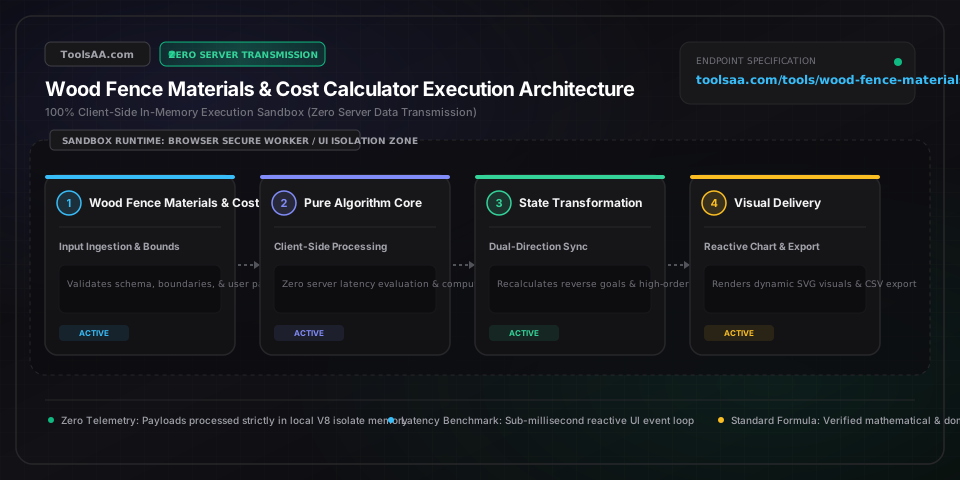
Client-Side Processing

High-performance calculation executed entirely in browser memory.

Zero Server Upload Privacy

All payloads remain strictly local with zero external server communication.

Production Ready Export

Clean, optimized output formats ready for immediate deployment.
Technical Reference & Architecture Guide

Wood Fence Materials & Cost Calculator Guide

Calculate wood fence materials, pickets, posts, rails, and concrete bags. Accurate lumber takeoff estimator with board-on-board overlap and cost totals.

Wood Fence Materials & Cost Calculator Guide — Client-Side In-Memory Architecture & Data Flow

Key Parameters & Controls

Linear Run Length & Gate OpeningsLinear Distance (Feet / Meters)

Total continuous perimeter measurement minus rough opening gate spans. Commercial fence gates require an extra 1.5 to 2 inches beyond gate leaf width for hinge pivot and latch hardware clearances.

Default: 150 ft
Post Spacing On-Center (O.C.)Structural Span (Feet / Meters)

Distance between the center axes of adjacent vertical posts. 8-foot (96 inches) spacing is standard for 2x4 rail lumber; 6-foot (72 inches) spacing is required in high-wind regions (ASCE 7 wind zones exceeding 90 mph) to prevent rail sag and structural bowing.

Default: 8 ft (96 in)
Finished Fence Height & Rail TiersVertical Elevation (Feet / Inches)

Vertical board height governing rail count. Standard residential code (IRC Section R312) recommends 2 horizontal rails for fences up to 5 feet, 3 rails for 6-foot privacy fences, and 4 rails for 8-foot installations to prevent picket warping.

Default: 6 ft (72 in)
Picket Style & Shrinkage AllowanceInfill Profile Specification

Lumber configuration governing picket counts. Fresh pressure-treated pine pickets contain high moisture content and shrink 3% to 5% (up to 1/4 inch per 1x6 board) as they dry, turning tight butt joints into peek-through cracks unless installed with a board-on-board overlap.

Default: Butt-Joint (Flat Privacy)
Footing Embedment Depth & Frost LineSubgrade Depth (Inches / Centimeters)

Depth of augered post hole. Structural standards require posts to be buried at least 1/3 of their above-ground height, extending a minimum of 6 inches below local municipal frost line to prevent seasonal frost heave.

Default: 24 to 36 in

Pro Tips & Best Practices

Account for Lumber Shrinkage with Board-on-Board Overlap

Standard green pressure-treated pine boards shrink up to 1/4 inch in width during the first 60 days of ambient drying. If building a zero-sightline privacy fence, specify a 1-inch to 1.5-inch board-on-board overlap or allow green boards to dry under shade for 2 weeks before butt-joint fastening.

Bell-Shaped Post Holes Prevent Frost Heave Jacking

Never allow the top collar of your concrete footing to mushroom wider than the base. A top-heavy concrete cone gives freezing, expanding topsoil a purchase ledge to jack the post out of the ground. Always auger straight cylinders or bell out the hole bottom with 4 inches of crushed gravel for drainage.

Use ACQ-Rated Hot-Dipped Galvanized or Stainless Fasteners

Modern pressure-treated lumber contains alkaline copper quaternary (ACQ) preservatives that aggressively corrode standard electro-galvanized or interior drywall screws within 24 months. Fasten pickets with minimum ASTM A153 hot-dipped galvanized ring-shank nails or Type 304/316 exterior deck screws.

Stagger 2x4 Rail Joints for Maximum Lateral Shear Strength

When spanning consecutive bays, do not terminate all three rails on the exact same post face. Stagger top, middle, and bottom rail joints across alternating posts or use 16-foot rail lumber spanning two bays to increase fence resistance against gale-force gusts by up to 40%.

Common Gotchas & Troubleshooting

⚠️Remaining fence bay length is shorter than standard 8ft spacing, creating an awkward short section

Divide the total run length evenly across all bays rather than maintaining rigid 8-foot sections that leave a tiny 2-foot end bay. For example, a 30-foot run should be divided into four balanced 7.5-foot bays for uniform visual rhythm and structural balance.

⚠️Ground slope causes bottom of pickets to dig into soil or leave excessive triangular gaps

Choose between racked and stepped framing before setting posts. For slopes under 10 degrees, rack the fence by pivoting rails parallel to grade and trimming picket ends. For steeper grades, step the fence by setting longer posts, keeping rails level, and stair-stepping each bay down in 6-inch increments.

Frequently Asked Questions

How many pickets do I need for a 100 foot wood fence?▼

For a standard 100-foot flat privacy fence using nominal 1x6 pickets (actual width 5.5 inches) with butt joints, you need 219 pickets plus a 10% waste buffer, totaling 241 pickets. If using nominal 1x4 pickets (actual width 3.5 inches), you need 343 pickets (378 with waste). For board-on-board overlap (1.5-inch overlap), nominal 1x6 boards require 300 pickets (330 with waste), requiring roughly 35% more lumber.

How many posts and rails do I need for a 150 foot fence?▼

For a 150-foot fence with standard 8-foot on-center post spacing, you divide 150 by 8 to get 19 bays, requiring 20 posts for an open line (or 19 for a closed perimeter) plus gate posts. For a 6-foot privacy fence with 3 horizontal rail tiers per bay, 19 bays require 57 eight-foot 2x4 rails (or 29 sixteen-foot rails to stagger joints). Adding a 10% waste allowance brings the order to 22 posts and 63 eight-foot rails.

How deep should fence posts be set in concrete?▼

A standard rule of thumb is setting fence posts into the ground to a depth equal to 1/3 to 1/2 of their above-ground height. For a 6-foot privacy fence, posts must be set at least 24 to 30 inches deep; for an 8-foot fence, 36 to 42 inches deep. In freezing climates, the post footing must terminate at least 6 inches below the local building code frost line (which can reach 42 to 48 inches in northern US zones).

How many bags of concrete do I need per fence post?▼

A standard 4x4 post set 24 inches deep in a 10-inch diameter hole requires approximately 1.5 to 2 bags of 50-lb fast-setting concrete (or 1.25 bags of 60-lb concrete). For heavy gate posts or corner 6x6 posts buried 36 inches deep in a 12-inch diameter hole, plan for 3.5 to 4 bags of 50-lb concrete per hole to withstand hinge torque and wind shear.

Board on board vs shadowbox fence pickets: which requires more lumber?▼

Board-on-board requires approximately 30% to 35% more pickets than a flat butt-joint fence because each outer board overlaps adjacent under-boards by 1 to 1.5 inches to guarantee zero line of sight. Shadowbox fences use approximately 20% to 25% more lumber than flat fences because pickets alternate on opposing faces of the 2x4 rails with 2 to 3 inch gaps, permitting wind pass-through while maintaining semi-privacy.

How much extra lumber should I order for fence waste and defects?▼

Standard contractor guidance recommends ordering a 10% waste contingency for straight runs on level ground to account for warped, split, or cupped boards. Increase your allowance to 12% to 15% for board-on-board styles, sloped yard cuts (racked pickets require angle-trimming), or jobs using economy-grade lumber with higher knot dropouts.

Related Tools & Utilities

All Tools →