Short title

Meat Freezer Storage Cost Calculator & ROI

Calculate meat freezer storage costs, bulk beef savings, and electricity run expense. Compare hanging weight to packaged cuts, chest freezer ROI, and store prices.

Lbl regime selector:
Btn presets
Sec carcass specs
LBS • $
Lbl hanging weight280 lbs
Lbl cut yield pct65%
Hint yield bonelessHint yield standardHint yield bone in
Lbl bone in trim bias(Lbl bone in trim notice)+0%
Lbl aging shrink pct4%
Sec financial outlays
Lbl total acquisition$1,659.00
Sec appliance thermal
Sec retail benchmark
Lbl quality tier:
Lbl annual inflation hedge4.2% / yr
Lbl spoilage risk reserve2%
Kpi net meat yield
174.7
lbs Lbl finished table cuts
Kpi landed cost unit
$10.03
Lbl per unit all in lbs Lbl all in
Kpi net savings total
$203.83
10.4% Lbl vs grocery
Kpi payback horizon
1.4 Unit years short
1.9 Lbl meat batches
Tab landed roi
$203.83 Lbl arbitrage gain
Lbl cost buildup vs groceryLbl benchmark $1,956.86
$1,358Lbl$301Lbl$94Sec$1,753Col$1,957Col$204Kpi
Lbl arbitrage yield spread
10.4%
Lbl grocery margin captured
Lbl unit economics diff
Lbl grocery avg$11.20 / lbs
Lbl your landed cost$10.03 / lbs
Lbl net arbitrage spread+$1.17 / lbs
Lbl appliance payback break even
Lbl freezer recovery period1.4 Unit years
Lbl max break even horizon45.4 Unit months
Lbl required usable space6.0 cu ft
Sec reverse solver
Hint target savings
Lbl max allowable farmer price:
$4.15 / lbs
Hint max farmer price
Kpi net meat yield174.7 lbs
Kpi landed cost unit$10.03 / lbs
Kpi net savings total$203.83
Kpi percentage savings10.4%
Kpi payback horizon1.4 Unit years
Kpi annual energy cost$35.48 / yr

Lbl disclosure title

Disclaimer text

Technical Reference & Architecture Guide

Meat Freezer Storage Cost Calculator & ROI Guide

Calculate meat freezer storage costs, bulk beef savings, and electricity run expense. Compare hanging weight to packaged cuts, chest freezer ROI, and store prices.

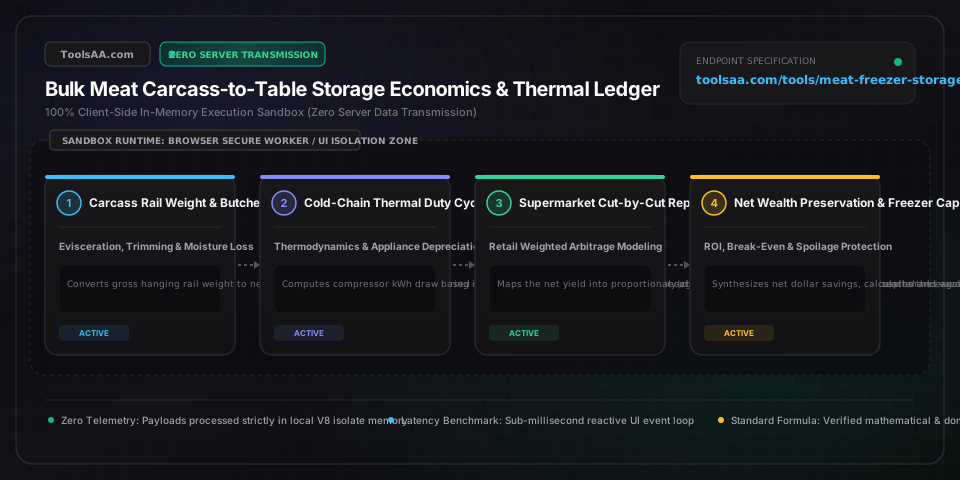
Meat Freezer Storage Cost Calculator & ROI Guide — Client-Side In-Memory Architecture & Data Flow

Key Parameters & Controls

Carcass Hanging Weight (Rail Weight)Mass (Avoirdupois Weight) / Wholesale Carcass Benchmark

The post-slaughter weight of the dressed animal carcass suspended on the abattoir rail after evisceration, hide skinning, and head/feet removal, serving as the official wholesale billing benchmark prior to dry aging and primal fabrication. For a standard 1,200 lb live steer, hanging weight typically measures 700 to 750 lbs (a 58% to 63% dressing percentage), dividing into ~175 to 190 lbs per quarter or ~350 to 375 lbs per half side.

Default: 280 lbs
Take-Home Cut & Wrap Dressing YieldPercentage / Net Fabrication Yield

The percentage of hanging carcass weight converted into edible, freezer-ready packaged meat after deboning, subcutaneous fat trimming, bone removal, gristle discard, and 3% to 5% dry-aging moisture shrinkage. University meat science benchmarks establish expected yields of 60% to 65% for standard bone-in beef (dropping to 50% to 56% for lean boneless cuts), 68% to 75% for market hogs, and 50% to 58% for wild venison.

Default: 64.0%
Butcher Cut & Wrap Processing FeeCurrency per Unit Weight / Abattoir Processing Tariff

The custom fabrication, vacuum packaging, and flash-freezing fee billed by certified state or USDA-inspected abattoirs, levied strictly against total hanging rail weight rather than finished boxed weight. Standard commercial rates span $0.85 to $1.35 per hanging pound, plus a flat harvest/slaughter fee ($60 to $120 per full head, prorated by fractional carcass ownership).

Default: $0.95 / lb
Annual Freezer Electricity ConsumptionElectrical Energy / Annual Grid Power Draw

The annual electrical consumption of the dedicated refrigeration unit in kilowatt-hours (kWh). Modern Energy Star certified manual-defrost chest freezers (7 to 15 cu ft) consume 180 to 250 kWh/year ($30 to $45/yr at $0.165/kWh national average), whereas upright frost-free units draw 400 to 650 kWh/year due to parasitic electric resistance defrost heaters cycling every 8 to 12 hours.

Default: 215 kWh / yr
Freezer Capital Cost AmortizationCurrency per Year / Straight-Line CapEx Depreciation

The initial capital expenditure of the dedicated chest or upright freezer depreciated over its operational economic life (standard straight-line lifespan of 12 to 15 years for manual chest freezers with hermetic compressors, or 8 to 10 years for upright models), allocating annualized equipment depreciation directly against bulk meat inventory cost basis.

Default: $31.67 / yr
Holding Duration & Consumption WindowTime Horizon / Inventory Turnover Velocity

The elapsed operational time horizon required for the household to fully consume the bulk meat inventory. Extended storage durations increase cumulative electrical operating expense (OpEx) and expose capital to foregone cash-yield opportunity costs (5% APY risk-free cash yields) and progressive food quality deterioration.

Default: 9 months
Freezer Usable Packing DensityVolumetric Density / Spatial Storage Coefficient

The spatial packaging efficiency required per unit of fabricated meat, calibrated at 32 to 35 lbs per cubic foot (or ~0.51 to 0.56 kg per liter) for square vacuum-sealed boneless cuts and ground blocks, vs 25 to 28 lbs/cu ft for irregular bone-in roasts, whole primal briskets, and poultry. Internal mechanical compressor humps and basket rails reduce nominal nameplate volume by 12% to 15%.

Default: 33.5 lbs / cu ft
Weighted Retail Replacement ValueCurrency per Unit Weight / Matched Retail Price Index

The volume-weighted composite supermarket retail price per pound reflecting the actual yield distribution of the carcass (typically 25% premium steaks retailing at $16 to $25/lb, 35% roasts and braising cuts at $9 to $15/lb, and 40% ground trim at $5 to $7/lb) across equivalent USDA Choice, Prime, or organic pasture-raised quality grades.

Default: $11.20 / lb
Pro Tips & Best Practices

Beware the Ground Beef Fallacy When Auditing Bulk Meat Break-Even

A frequent financial modeling error is evaluating bulk beef economics against supermarket ground beef sales. A standard half beef side yields roughly 25% premium loin and rib steaks (Ribeyes, NY Strips, Tenderloins) that command $18 to $26/lb retail, 35% roasts, briskets, and stew meat at $9 to $14/lb, and only 40% ground beef trim ($5.50 to $7.00/lb). Benchmark your purchase against this volume-weighted composite basket ($11.00 to $13.50/lb aggregate value) rather than bottom-tier commodity ground mince to reflect accurate economic alpha.

Avoid Upright Frost-Free Freezers for Long-Term Storage Horizons

Upright frost-free freezers incorporate automated electric resistance heating coils that cycle to 32°F (0°C) every 8 to 12 hours to melt ice from internal evaporator coils. This periodic thermal oscillation sublimates intra-cellular moisture out of the meat fibers, causing severe freezer burn, lipid oxidation, and moisture loss within 4 to 6 months. Manual defrost chest freezers maintain continuous -0°F to -10°F (-18°C to -23°C) vapor locks, preserving barrier vacuum pouches for 24 to 36 months without cellular degradation.

Factor Garage Ambient Temperature Spikes into Utility Operating Cost

Operating an unconditioned chest freezer in an attached garage where summer ambient temperatures hit 95°F to 105°F (35°C to 41°C) can double or triple compressor duty cycles, elevating annual consumption from 215 kWh to over 480 kWh ($80+ additional OpEx). Maintain at least 3 inches of peripheral airflow clearance around side-skin condensers, clean dust accumulation twice yearly, and consider thermal insulated foam top blankets to prevent thermal leakage through lid gaskets.

Incorporate Opportunity Cost of Capital into Your Wholesale Meat ROI

Purchasing a whole beef ($3,000 to $4,500 upfront cash outlay) incurs an implicit opportunity cost. At a 5.0% risk-free APY in Treasury bills or money market funds, committing $3,500 upfront forfeits $175 in annual after-tax passive interest income. Ensure your projected bulk butcher discount exceeds this capital hurdle rate plus storage operating expenses before locking liquidity into physical frozen meat inventory.

Common Gotchas & Troubleshooting

⚠️The butcher cut-and-wrap invoice exceeds expectations relative to the advertised farm price.

Farmers and custom abattoirs invoice cut-and-wrap processing fees based on gross hanging carcass weight on the rail, NOT on final boxed take-home weight. If a 300 lb hanging quarter incurs a $1.00/lb cut fee and yields 192 lbs of packaged meat (64% yield), the effective processing cost is $1.56 per take-home pound ($300 / 192 lbs). Add carcass kill/disposal fees ($40 to $80 pro-rated) and specialty sausage seasonings to determine your true landed cost basis.

⚠️Freezer burn, dry gray discoloration, and ice crystals developing inside sealed pouches within 6 months.

Internal ice crystal formation signifies either thermal cycling from an auto-defrost cycle or micro-breaches in the packaging barrier. For vacuum-sealed meats, bone tips on T-bones and short ribs frequently puncture standard 3-mil pouches; require 5-mil heavy-duty bags or wax bone-guard covers from your processor. For traditional paper wraps, ensure double-wrapping (waxed poly-coated freezer wrap over inner stretch film) and verify that storage temps remain strictly below 0°F (-18°C).

⚠️Prolonged holding duration is eroding net economic savings over supermarket retail.

Calculate your holding horizon break-even point. In high-tariff electricity markets ($0.30 to $0.45/kWh, such as California, Hawaii, or parts of Europe), a 10 cu ft chest freezer consuming 280 kWh/yr costs $85 to $125 annually. If a two-person household takes 24 months to consume a quarter cow, cumulative power ($200) plus appliance depreciation ($60) can entirely wipe out a $250 bulk discount. Target an inventory turnover velocity of 4 to 6 lbs per week to deplete inventory within 9 to 12 months.

⚠️Packaged frozen meat volume exceeds the physical cubic capacity of the freezer.

Packaged meat packing density varies drastically by butchery cut specification. Dense ground beef chubs pack at 35 to 40 lbs per cubic foot, while bone-in roasts, whole turkeys, and soup marrow bones pack at only 24 to 28 lbs/cu ft. Additionally, internal wire baskets and compressor step humps consume 15% of gross internal volume. Apply an 80% usable volume derating factor: divide total take-home meat weight by 28 lbs/cu ft to ensure adequate capacity.

Frequently Asked Questions

How to calculate the real cost per pound of a quarter or half cow?▼

To calculate the true cost per edible pound of bulk beef, use the formula: True Cost/lb = [(Hanging Weight × Farm Hanging Price) + (Hanging Weight × Butcher Cut & Wrap Fee) + Harvest Kill Fee + Allocated Freezer Electricity & Amortization] / (Hanging Weight × Dressing Yield Percentage). For example, a 300 lb hanging quarter purchased at $4.50/lb with a $1.00/lb butchering fee, $35 kill charge, and $30 storage electricity yields 192 lbs of packaged meat at a 64% yield. The total cash outlay of $1,715 results in a true landed cost of $8.93 per packaged pound ($1,715 / 192 lbs), delivering a 20% to 35% discount against matched supermarket cuts.

How much electricity does a meat chest freezer use per year?▼

A standard Energy Star certified manual-defrost chest freezer (7 to 10 cubic feet) consumes between 190 and 240 kWh of electricity per year, costing $31 to $40 annually based on the US residential average rate of $0.165/kWh. By comparison, an upright frost-free freezer of equivalent capacity consumes 400 to 650 kWh annually ($66 to $107/year) because electric heating elements intermittently cycle on to melt internal evaporator coil frost, doubling continuous operational energy cost.

What is the difference between hanging weight and take-home cut weight?▼

Hanging weight (also known as rail weight or carcass weight) is the weight of the slaughtered animal after evisceration, bleeding, and removal of the hide, head, and hooves, recorded before cooling and fabrication. Take-home cut weight is the actual net weight of edible meat cuts wrapped and boxed for consumer freezers after deboning, fat trimming, gristle discard, and 3% to 5% dry-aging moisture loss. Typical take-home yields range from 60% to 65% of hanging weight for beef (50% to 56% for completely boneless cuts), 68% to 75% for hogs, and 50% to 58% for wild game.

How long can meat stay in a deep freezer before losing quality or money?▼

Under USDA food safety guidelines, meat kept continuously frozen at 0°F (-18°C) or colder remains microbiologically safe indefinitely; however, culinary quality in heavy vacuum packaging peaks within 24 to 36 months for beef steaks and roasts, 12 months for ground beef, and 6 to 9 months for pork or poultry. Financially, holding bulk inventory beyond 12 to 15 months becomes suboptimal, as ongoing electrical consumption ($35 to $80/yr), appliance depreciation, and foregone 5% cash interest on invested funds progressively erode initial wholesale procurement savings.

How big of a freezer do I need for a quarter cow or half cow?▼

Allocate 1 cubic foot of usable freezer space for every 30 to 35 pounds of vacuum-packaged meat cuts. A typical quarter cow yielding 120 to 180 pounds of packaged meat requires a 4.5 to 6.0 cubic foot chest freezer. A half cow yielding 240 to 350 pounds requires an 8.0 to 12.0 cubic foot freezer, and a whole beef yielding 500 to 700 pounds requires an 18 to 22 cubic foot freezer or two dedicated 10 cubic foot units for organized inventory rotation.

Is buying a freezer and bulk meat actually cheaper than the grocery store?▼

Disclaimer: This tool is provided strictly for educational and informational purposes only and does not constitute formal financial advice or a binding loan commitment. Please consult a qualified financial advisor before making decisions. Yes, purchasing a quarter or half cow delivers typical net household savings of $400 to $1,200 per animal cycle compared to supermarket retail prices for equivalent USDA Choice or grass-fed beef, representing an average cost reduction of 25% to 40%. These savings fully amortize the initial $300 to $600 capital purchase price of an Energy Star chest freezer within the very first or second beef purchase cycle, generating an annualized return on invested capital (ROIC) exceeding 45%.

Related Tools & Utilities

All Tools →