Sleep Debt Calculator & Recovery Planner

Sleep Debt Calculator & Recovery Planner

Calculate cumulative sleep debt and recovery sleep needed across 7 to 14 days. Balance nightly deficits, optimize wake times, and restore cognitive alertness.

Lbl load sample
Lbl regime and baseline
Lbl biological need8.00 Unit hours per night
Lbl awakenings1 Unit times

Hint awakenings desc

Lbl daily log title
Lbl dayLbl bedtimeLbl wake timeLbl efficiencyLbl calculated sleepLbl nightly delta
Mon
88%
6h 22m-1.6h
Tue
86%
6h 1m-2.0h
Wed
85%
5h 45m-2.3h
Thu
84%
5h 28m-2.5h
Fri
89%
5h 48m-2.2h
Sat
92%
7h 6m-0.9h
Sun
87%
6h 18m-1.7h
Desc daily log
Lbl recovery parameters
Lbl wake anchor desc
(7:00 AM)
7 Unit days
Lbl caffeine advisor10:49 AM
mg

Lbl caffeine half life hint

Kpi total debt
13.2Unit hours
Moderate Debt
Kpi pvt lapses
3x
Hint reaction delay
Kpi bac equivalent
~0.08%
Hint alcohol equiv
Kpi recommended bedtime
8:19 PM
+60 Unit minutes Hint recharge

Lbl debt gauge title

Reflects Process S homeostatic pressure and adenosine accumulation in prefrontal cortex.

Moderate
13.2h / 20.0h Hint max
0h5h10h15h20h
Lbl daily extension quota
+60 Unit minutes

Desc extension cap

Lbl nap prescription
20 Unit minutes

Lbl scheduled 2:00 PM - 3:30 PM.

Lbl optimal sleep cycles
6 Unit cycles (9h)

Desc cycles grogginess

Stat average sleep6.1 Unit hours / Lbl night
Stat efficiency index87%
Stat projected recovery7 Unit days (+60Unit minutes)

Disclaimer text

Technical Reference & Architecture Guide

Sleep Debt Calculator & Recovery Planner Guide

Calculate cumulative sleep debt and recovery sleep needed across 7 to 14 days. Balance nightly deficits, optimize wake times, and restore cognitive alertness.

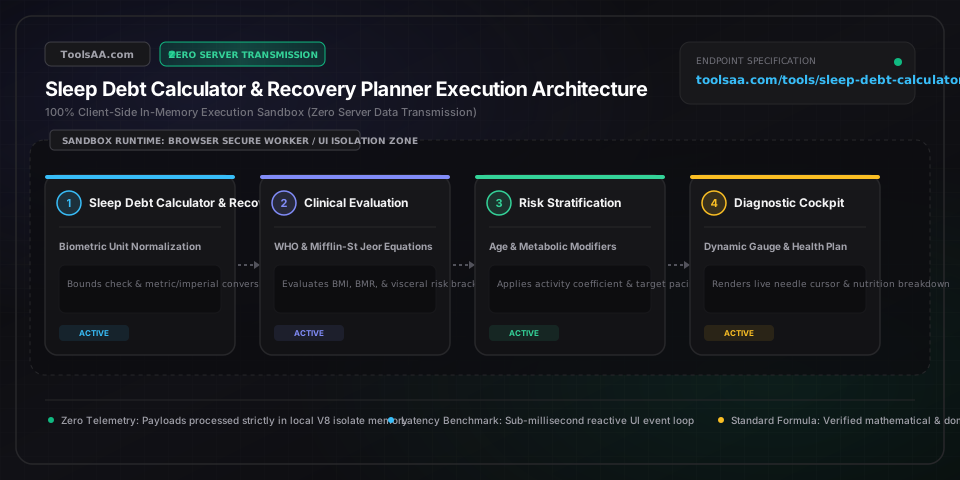
Sleep Debt Calculator & Recovery Planner Guide — Client-Side In-Memory Architecture & Data Flow

Key Parameters & Controls

Biological Sleep Need (Homeostatic Quota)Duration in Decimal Hours (AASM & NSF Gold Standard)

The genetically and developmentally determined nightly sleep duration required to maintain optimal neurocognitive, metabolic, and immunological function without daytime somnolence. Governed by the Two-Process Model of Sleep Regulation (Borbely, 1982), where Process S homeostatic sleep pressure (adenosine accumulation) balances with Process C circadian wake drive. Clinical guidelines from the American Academy of Sleep Medicine (AASM) establish 7.0 to 9.0 hours for adults (18-64), 7.5 to 9.5 hours for young adults, and 8.5 to 10.0 hours for high-performance athletes.

Default: 8.0 Hours (Adult Baseline)
Actual Total Sleep Time (TST)Effective Restorative Duration in Hours

The exact physiological duration spent in non-rapid eye movement (NREM Stages N1, N2, N3 Slow-Wave Sleep) and rapid eye movement (REM) sleep, distinct from total Time in Bed (TIB). TST excludes sleep onset latency (time to fall asleep, typically 10-20 minutes) and wake after sleep onset (WASO nocturnal awakenings). Only actual TST clears adenosine from the basal forebrain and allows glymphatic brain waste clearance.

Default: 6.5 Hours (Typical Deficit Input)
Sleep Efficiency Index (SEI)Percentage Ratio (TST / TIB x 100%)

The proportion of time spent in bed that is actually spent sleeping. A clinical gold standard SEI is 85% or greater; values below 80% indicate significant sleep fragmentation, insomnia, or environmental sleep disturbance. When SEI falls below 85%, nominal bed time severely overestimates restorative sleep, causing unmeasured, compounding sleep debt.

Default: 88.0% (Normal Clinical Benchmark)
Cumulative Sleep Debt BalanceRunning Delta Balance in Hours (Negative Hours Deficit)

The cumulative mathematical deficit accrued over a rolling 7-to-14 day window, calculated as the sum of nightly deficits: Sum(Biological Need - Actual TST). Clinical thresholds define debt severity: Nominal (0 to 2 hrs), Mild (2 to 5 hrs, modest daytime drowsiness), Moderate (5 to 10 hrs, measurable executive function decline), Severe (10 to 15 hrs, vigilance lapses matching BAC 0.05%), and Chronic Sleep Deprivation (>15 hrs, severe neurobehavioral impairment and metabolic dysregulation).

Default: -6.5 Hours (Subclinical Moderate Deficit)
Catch-Up Repayment VelocityIncremental Sleep Extension Rate (Minutes per Night)

The clinically safe nightly sleep extension increment applied to repay accumulated debt without disrupting the central circadian pacemaker (suprachiasmatic nucleus). Research from sleep physiology demonstrates that extending sleep by 30 to 60 minutes per night—combined with 20-minute afternoon power naps—efficiently clears debt across 7 to 10 days while preventing sleep drunkenness (sleep inertia) and circadian phase delay.

Default: +45 Minutes / Night (Safe Repayment Pace)
Social Jetlag (Delta Midpoint of Sleep)Chronobiological Discrepancy in Hours / Minutes

The absolute time difference between the midpoint of sleep on workdays (MSW) and the midpoint of sleep on free weekend days (MSFsc = Sleep Start + 0.5 x Sleep Duration). A social jetlag exceeding 1.0 hour indicates substantial circadian misalignment, which elevates cardiometabolic risk, promotes Sunday night insomnia, and impairs Monday cognitive performance regardless of total hours slept.

Default: 1 Hour 15 Minutes (Moderate Social Jetlag)
Pro Tips & Best Practices

Binge-Sleeping on Weekends Destroys Circadian Entrainment and Triggers Social Jetlag

Sleeping 11 to 12 hours on Sunday morning to repay weeklong debt shifts your central circadian pacemaker by up to two hours. This phase delay prevents melatonin release Sunday night, causing acute sleep-onset insomnia, morning grogginess on Monday, and a renewed sleep debt cycle. Instead, cap weekend wake-up times to within 60 minutes of your weekday alarm and repay debt with an afternoon power nap between 13:00 and 15:00.

Account for Time in Bed (TIB) vs Actual Sleep Time: The 15% Invisible Deficit

Spending 8 hours in bed does not equal 8 hours of sleep. Healthy adults experience 15 to 20 minutes of sleep onset latency and 20 to 40 minutes of brief micro-awakenings, yielding an average sleep efficiency of 85% to 88%. If you spend 8.0 hours in bed, your true restorative sleep is approximately 6.8 to 7.0 hours. Factor in a 45-minute buffer zone to ensure your biological quota is genuinely satisfied.

Cap Restorative Power Naps at 25 Minutes to Prevent Sleep Drunkenness

Daytime naps longer than 30 minutes allow the brain to descend into Stage N3 slow-wave deep sleep. Waking from deep sleep triggers intense sleep inertia (grogginess, disorientation, and reduced motor speed lasting up to 60 minutes) and depletes nighttime adenosine pressure. A 20-to-25 minute nap stays entirely within light Stage N2 sleep, rapidly restoring cognitive alertness without affecting nocturnal sleep onset.

Adenosine Clearance Is Non-Linear: Prioritize Slow-Wave Sleep in the First 3 Nights

When recovering from acute sleep debt, the brain prioritizes Stage N3 slow-wave sleep (SWS) over REM sleep during the first 2 to 3 recovery nights. SWS is where delta-wave power surges, growth hormone is secreted, and the glymphatic system clears metabolic toxins. Do not expect cognitive reaction speed to normalize instantly; neurobehavioral recovery lags physiological deep-sleep replenishment by 48 to 72 hours.

Enforce a Strict Caffeine Curfew 10 Hours Prior to Prescribed Bedtime

Caffeine is a competitive adenosine receptor antagonist with an average metabolic half-life of 5 to 7 hours and a quarter-life of 10 to 12 hours. Consuming 200 mg of caffeine at 16:00 leaves 50 mg active at 02:00, which binds to A1/A2A adenosine receptors and blocks deep restorative slow-wave sleep by up to 20%, even if you fall asleep promptly. Cut off caffeine 10 hours before your recovery bedtime.

Common Gotchas & Troubleshooting

⚠️Woke up feeling exhausted and disoriented after a 10-hour weekend catch-up sleep

This condition is known as sleep inertia or sleep drunkenness, caused by waking abruptly from Stage N3 slow-wave sleep combined with circadian phase misalignment. Avoid single mega-sleep sessions exceeding 9.5 hours. Instead, wake at your normal time plus 60 minutes, get 15 minutes of direct morning sunlight to reset your cortisol curve, and repay remaining debt through an early bedtime the following night.

⚠️Calculated bedtime for debt recovery is 21:00, but wide awake and unable to fall asleep

You are encountering the physiological wake maintenance zone (or forbidden sleep zone), an evolutionary surge in circadian alertness that occurs 2 to 3 hours before habitual melatonin onset. You cannot force sleep during this window. Advance bedtime gradually by just 20 to 30 minutes every two nights, dim household lighting below 50 lux at 20:00, and use a warm 10-minute shower to trigger core body temperature vasodilation.

⚠️Alarm rings according to the calculated schedule, but cognitive brain fog lingers all day

Check your Sleep Efficiency Index (SEI) and alcohol or medication intake. Alcohol consumed within 3 hours of sleep fragments REM architecture and suppresses vasopressin, causing micro-arousals and dehydration. If total hours match your quota but exhaustion persists, evaluate for obstructive sleep apnea (OSA) or upper airway resistance, where oxygen desaturations destroy sleep restorative quality despite 8 hours in bed.

⚠️Rotating shift schedule makes maintaining a consistent daily wake-up anchor impossible

Adopt the anchor sleep protocol: identify a core 4-hour window that overlaps between your day shift and night shift routines (such as 08:00 to 12:00). Keep this core block dark and protected daily using blackout blinds and white noise, and supplement with a flexible 3-hour secondary sleep episode or prophylactic 90-minute nap prior to your night shift.

⚠️Daily caffeine consumption makes estimating true baseline sleepiness and debt difficult

Caffeine artificially masks homeostatic sleep drive by blocking adenosine receptors without reducing biological debt. To uncover your true debt baseline, perform a weekend self-test: eliminate afternoon caffeine for two consecutive days, maintain a dark bedroom, and record your natural, spontaneous wake-up time without an alarm on Sunday morning.

Frequently Asked Questions

How to calculate sleep debt accurately with the medical formula?▼

Sleep debt is calculated using the formula: Cumulative Sleep Debt = Sum over 7 to 14 days of [Biological Sleep Need - Actual Total Sleep Time]. For example, if your biological baseline need is 8.0 hours and you slept 6.5 hours Monday through Friday, your workweek deficit is 5 x (8.0 - 6.5) = 7.5 hours of accumulated sleep debt. To account for sleep quality, multiply Time in Bed by your Sleep Efficiency Index (typically 85-90%) before subtracting from your baseline need.

Can you actually catch up on sleep debt or is the damage permanent?▼

Yes, short-term acute sleep debt (accrued over days to weeks) can be substantially recovered through consistent sleep extension, but recovery is non-linear and cannot be achieved in a single weekend marathon. Chronic sleep deprivation lasting months or years causes epigenetic, cardiovascular, and metabolic adaptations that take extended lifestyle intervention to normalize. Controlled studies show that clearing 10 hours of acute debt requires 3 to 7 consecutive nights of 8.5 to 9.0 hours of sleep.

How long does it take to recover from 10 hours of accumulated sleep debt?▼

Recovering from 10 hours of sleep debt safely requires approximately 7 to 10 days of structured sleep extension. The optimal physiological recovery protocol is adding 45 to 60 minutes of nocturnal sleep each night (e.g., going to bed at 22:15 instead of 23:00) paired with an optional 20-minute afternoon power nap. This gradual approach repays 1.0 to 1.3 hours of debt daily without causing Sunday night insomnia or circadian rhythm disruption.

What is the difference between sleep debt and social jetlag?▼

Sleep debt is a quantitative deficiency in total hours of sleep relative to biological need, governed by homeostatic sleep pressure (Process S). Social jetlag is a chronobiological phase discrepancy between your biological circadian clock (Process C) and your social schedule, measured by the difference in your sleep midpoint between workdays and free days. You can have severe social jetlag even with zero sleep debt if you sleep 8 hours from 23:00 to 07:00 on weekdays but 8 hours from 03:00 to 11:00 on weekends.

What are the cognitive and physical risks of chronic sleep debt?▼

Accumulating more than 10 hours of sleep debt degrades neurobehavioral performance to levels equivalent to legal alcohol intoxication: 24 hours of wakefulness or a week of 5 hours of nightly sleep impairs psychomotor reaction times equivalently to a 0.10% blood alcohol concentration (BAC). Physically, chronic debt elevates evening cortisol, reduces insulin sensitivity by 30%, suppresses natural killer immune cells by up to 70%, and impairs the glymphatic clearance of amyloid-beta proteins from brain tissue.

How do 90-minute sleep cycles prevent waking up tired during debt recovery?▼

Disclaimer: This tool is provided strictly for educational and informational purposes only and does not constitute formal financial advice or a binding loan commitment. Please consult a qualified financial advisor before making decisions. Human sleep is structured into ultradian cycles lasting approximately 90 to 110 minutes, transitioning from light sleep (N1/N2) down to deep slow-wave sleep (N3) and back up to REM sleep. Waking up in the middle of Stage N3 deep sleep causes intense sleep inertia, leaving you groggy for up to an hour. Planning sleep durations in multiples of 90 minutes (such as 7.5 hours [5 cycles] or 9.0 hours [6 cycles]) ensures your alarm triggers during lighter N1/REM phases for effortless morning alertness.

Related Tools & Utilities

All Tools →