Hint base sign
Alert steep desc
Hint click to expand biometrics
Calculate total tree height using two-angle clinometer sights and slope distance. Adjust for eye height, ground slope, crown ratio, and timber fell clearance zones.
Hint base sign
Alert steep desc
Hint click to expand biometrics
Calculate total tree height using two-angle clinometer sights and slope distance. Adjust for eye height, ground slope, crown ratio, and timber fell clearance zones.
Optical inclination angle measured from observer eye level to the uppermost living vegetative leader of the tree crown. Best measured between 30° and 45° to minimize tangent multiplication volatility.
Optical sight angle to the true ground root flare of the trunk. Sights below horizontal datum are signed negative; uphill sights where tree base sits above eye level are signed positive.
True level orthogonal distance between observer plumb line and tree trunk center. When surface slope tape is used, equals Slope Distance multiplied by cos(ground slope).
Inclination of ground surface along the sight path. Used in cosine reduction to correct tape distance stretched directly against inclined hillside terrain.
Vertical elevation of observer pupils above ground footing. Calibrates baseline level when using simplified single-angle tangent mode on flat terrain.
Outside-bark stem diameter measured at standard 4.5 ft (1.37 m) above root collar. Drives commercial sawlog volume calculations using Doyle or International 1/4-inch rules.
Always position your setback distance approximately equal to estimated tree height (sighting top at ~45°). Sighting steeper than 55° exponentially amplifies error because the tangent curve derivative (sec^2 theta) escalates rapidly: a 1° sighting error at 60° causes over 3x the height distortion of the same 1° error at 45°.
Never measure a leaning tree along its plane of lean (facing or retreating from the lean), as foreshortening creates massive trigonometric bias. Always step 90 degrees perpendicular to the lean direction so the full tilt is visible across your field of view without distance compression.
Double-check your clinometer reticle wheel. A 100% grade reading does NOT mean vertical; it represents a 1:1 rise/run slope, which is exactly 45.0 degrees. Sighting an 80-foot tree from 66 feet with a percent scale requires dividing the scale difference by 100, whereas degree scales require trigonometric tangent conversions.
From close distances, rounded broadleaf crowns (oaks, maples) cause observers to mistake a prominent front lateral branch for the true central apex. Back away to at least 1.5x the tree height so the actual apical crown summit clears the frontal branch foliage in your optical sightline.
Check your base angle algebraic sign. If sighting downhill to the tree base (-5°), the two-angle formula subtracts a negative number (tan(top) - tan(-base)), which adds the heights. If entered as positive (+5°), the calculator erroneously subtracts the ground trunk segment instead of adding it.
You are likely using direct surface tape distance without slope reduction. A 100-foot tape pulled across a 25-degree hillside corresponds to only 90.6 feet of actual horizontal distance. Switch distance type to 'Slope Distance Tape' and input the hillside grade so cosine correction is applied.
Mount a high-visibility target pole or have a field partner hold a 5.0-foot (or 2.0-meter) blaze-orange marker rod against the trunk. Sight to the visible marker top, calculate height to the rod, and simply add the known rod height to finalize total tree height.
Damping fluid in optical clinometers thickens in sub-freezing temperatures. Use the open-sight binocular technique: keep both eyes open, superimposing the internal illuminated optical scale seen by your dominant eye directly onto the real tree seen by your naked eye.
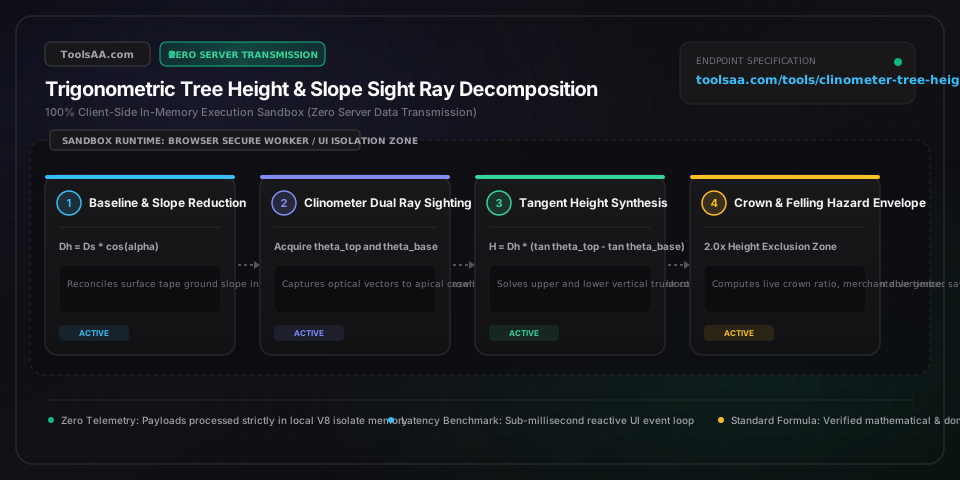
To calculate tree height, stand at a known horizontal distance (D) from the trunk and sight the top and base with a clinometer. Total height is H = D * (tan(theta_top) - tan(theta_base)). When sighting the base below eye level, the base angle is negative, meaning the two vertical heights add together: H = D * tan(theta_top) + D * tan(|theta_base|).
The universal two-angle formula is Height = Baseline_Distance * [tan(Top_Angle) - tan(Base_Angle)]. Because angles below horizontal are mathematically negative, subtracting a negative base angle automatically sums the crown portion above your eye line and the trunk portion below your eye line.
When pulling a tape measure along sloping terrain, you measure Slope Distance (Ds) rather than Horizontal Distance (Dh). You must correct this using the cosine of the terrain slope angle (alpha): Dh = Ds * cos(alpha). Use this corrected Dh in your tangent height equation to avoid significant height overestimation.
Degree clinometers measure pure angle from 0° (level) to 90° (vertical zenith), requiring tangent calculation. Percent grade clinometers measure vertical rise per 100 units of horizontal run. At a 100-foot baseline, every 1% grade directly equals 1 foot of height; at a 66-foot (1 chain) baseline, every 1% grade equals 0.66 feet.
The professional standard distance is approximately equal to the total tree height (a 1:1 ratio), which produces a top sighting angle between 40° and 45°. Standing closer than a 45° sight angle dramatically increases error from instrument tilt, while standing too far back can obscure the true crown top in dense canopy.
When standing downhill where the tree base sits above your eye line, both top and base angles are positive inclinations. The formula remains Height = Distance * [tan(Top_Angle) - tan(Base_Angle)], which correctly subtracts the blank hillside space between your eye level and the elevated tree stump.
Calculate chi-square test statistic, p-value, expected frequencies, and Cramér's V from 2x2 to 10x10 contingency tables or goodness-of-fit data instantly.
Interactive Catenary Sag & Overhead Span Tension Calculator with real-time client-side analysis and visualization.
Calculate Macaulay duration, modified duration, convexity, and DV01 for fixed-income bonds. Simulate yield curve shocks with exact Taylor series repricing.
Interactive Baker's Percentage Calculator & Dough Formula Scaler with real-time client-side analysis and visualization.
Interactive Dimensional Weight Calculator & Chargeable Weight with real-time client-side analysis and visualization.
Calculate container loading capacity and CBM for 20ft, 40ft, and 40HQ ocean freight. Optimize carton packing, pallet count, payload weight, and container stuffing.