ISO 668 Internal DimensionsLength × Width × Height (mm or in)
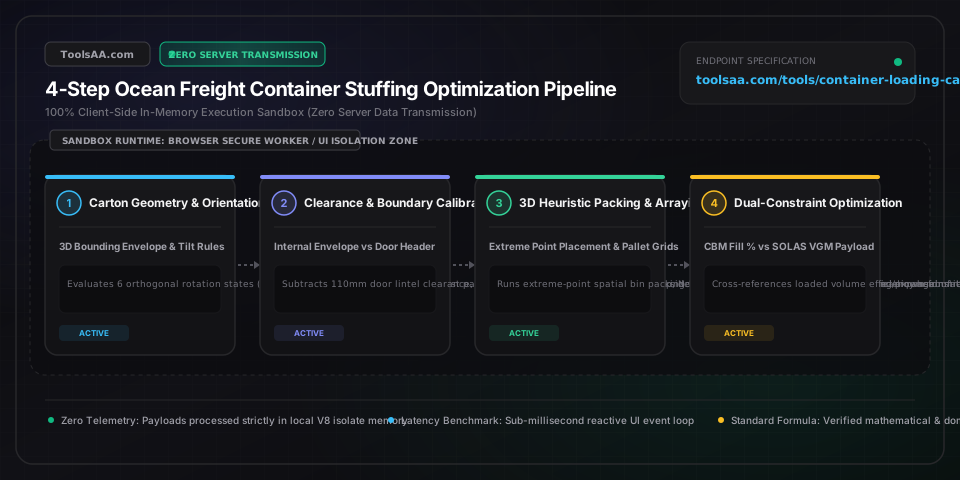
Official usable internal dimensions inside standard corrugated sea containers. Standard 20ft GP measures 5,898 × 2,352 × 2,393 mm (usable ~33.2 CBM); 40ft GP measures 12,032 × 2,352 × 2,393 mm (usable ~67.7 CBM); 40ft HQ measures 12,032 × 2,352 × 2,698 mm (usable ~76.4 CBM).
Default: 12,032 × 2,352 × 2,698 mm (40HQ)
SOLAS VGM Max Cargo PayloadMetric Tonnes / Kilograms (or Lbs)
Statutory maximum cargo payload rating calculated as Container Maximum Gross Mass (typically 30,480 kg / 67,200 lbs) minus Tare Weight of the empty container (approx. 2,200 kg for 20ft, 3,750 kg for 40ft, 3,900 kg for 40HQ). Real-world road weight limits often restrict gross payload further to 20,000–22,000 kg depending on country highway regulations.
Default: 26,580 kg (40HQ Gross Payload)
Corrugated Bulging Allowance FactorExpansion Ratio (1.00 to 1.05)
Empirical physical expansion coefficient of cardboard master cartons under compression, humidity, and tape sealing. A standard 400 × 300 mm carton typically swells to 408 × 306 mm (+2%) when stacked 6-high on marine transits, which can eliminate up to 8% of calculated carton capacity.
Default: 1.015 (+1.5%)
Rear Door Entry Clearance EnvelopeDoor Width × Door Height (mm or in)
Physical clearance through the rear container door frame. Door height is consistently 80–110 mm lower than interior ceiling height (40ft GP door height is 2,280 mm vs internal 2,393 mm; 40HQ door height is 2,585 mm vs internal 2,698 mm). Cargo taller than door aperture cannot be loaded even if internal headspace exists.
Default: 2,340 × 2,585 mm (40HQ Door)
Pallet Unitization Dimensions & TareStandard Footprint × Height (mm)
Standard industrial pallet bases. EUR 1 (800 × 1,200 mm) fits 11 units in a 20ft container or 24–25 in a 40ft container in single tier. US GMA (1,000 × 1,200 mm / 48 × 40 in) fits 10 units in 20ft or 20–21 in 40ft. Wooden pallets add 140–160 mm tare height and 18–25 kg dead weight per unit.
Default: 1,200 × 800 × 150 mm (EUR-1)
Axle Weight & Center of Gravity BoundaryLongitudinal Distribution Balance (%)
IMO/ILO/UNECE Code of Practice for Packing of Cargo Transport Units (CTU Code) specifies that no single half of the container length should bear more than 60% of the total cargo weight, preventing chassis failure, terminal gantry tipping, and highway vehicle bridge formula violations.
Default: 50% ± 5% Center Balance