CBM Calculator & Freight Volume (CFT)

CBM Calculator & Freight Volume (CFT)

Calculate shipment CBM, cubic feet (CFT), dimensional chargeable weight across Air, Ocean LCL, and Express courier modes, and optimize 20ft/40ft container stuffing capacity.

100% Client-Side Privacy
Badge w m rule
Lbl quick scenarios
Lbl unit system
Lbl freight mode
Title manifest2 Lbl lots count

Desc manifest

Col hashCol descriptionCol packaging typeCol length (Unit cm)Col width (Unit cm)Col height (Unit cm)Col quantityCol unit weight (Unit kg)Col subtotal cbmCol action
12.880 Unit cbm
20.945 Unit cbm
Lbl total packages 50 Unit pieces•Lbl active divisor 1000
Title stacking factors
Lbl stowage standard

Hint stowage loss

Lbl auto palletDesc auto pallet
Hint custom divisor
Title reverse solver

Desc reverse solver

Lbl max volume fit359 Unit cartons
Lbl max weight fit2350 Unit cartons
Lbl net capacity359 Unit cartons
Lbl residual volume0.07 Unit cbm
Lbl governing bottleneckBottleneck volume
Title kpi cockpit
Lbl total cbm
3.825 Unit cbm
= 135.08 Unit cft
Lbl chargeable weight
3,825.00 Unit kg
= 8,432.7 Unit lbs
Lbl volumetric governsDesc volumetric cargo
Lbl actual vs dimensionalLbl density ratio 161.0 kg/m³
Lbl gross weight616.00 Unit kg
Lbl volumetric weight3,825.00 Unit kg
Title container meter
15.2% Lbl volume text3.83 / 25.2 Lbl cbm usable20ft Standard (20' GP) (20GP)Lbl payload cap: 28,200 Unit kgLbl internal dims: 5.898m L × 2.352m W × 2.393m H
20ft Standard (20' GP) (28 Unit cbm Lbl usable)
Lbl vol short: 15.2%|Lbl wt short: 2.2%
40ft Standard (40' GP) (58 Unit cbm Lbl usable)
Lbl vol short: 7.3%|Lbl wt short: 2.3%
40ft High Cube (40' HC) (68 Unit cbm Lbl usable)
Lbl vol short: 6.3%|Lbl wt short: 2.3%
45ft High Cube (45' HC) (75 Unit cbm Lbl usable)
Lbl vol short: 5.7%|Lbl wt short: 2.2%
Title export dock

Desc export dock

Stats total cbm3.825 Unit cbm
Stats chargeable wt3,825.00 Unit kg
Stats optimal fit20GP
Stats rating ruleRule volumetric short
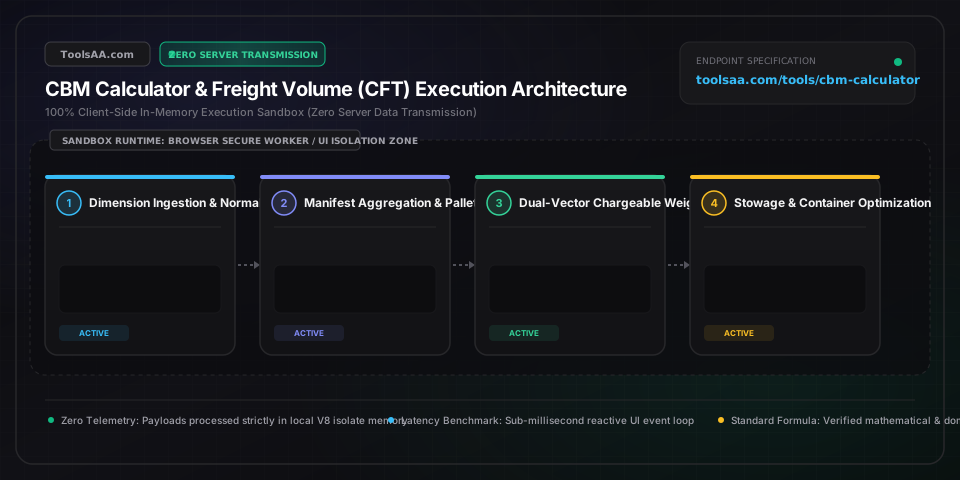
Technical Reference & Architecture Guide

CBM Calculator & Freight Volume (CFT) Guide

Calculate shipment CBM, cubic feet (CFT), dimensional chargeable weight across Air, Ocean LCL, and Express courier modes, and optimize 20ft/40ft container stuffing capacity.

CBM Calculator & Freight Volume (CFT) Guide — Client-Side In-Memory Architecture & Data Flow

Key Parameters & Controls

Cubic Meter (CBM / m³) Freight VolumeVolume Unit (m³ / CFT)

The international standard volume benchmark for maritime, air, and domestic freight. One cubic meter equals 1,000,000 cubic centimeters, 35.3147 cubic feet (CFT), or 61,023.7 cubic inches. Calculated as Length × Width × Height × Total Carton Count in meters.

Default: 1.0 m³ (35.315 CFT)
Dimensional Weight Divisor (DIM Factor)Volumetric Density Ratio (cm³/kg)

The logistics carrier density benchmark determining whether cargo is billed by physical weight or cubic space footprint. International IATA air freight enforces 6,000 cm³/kg (166.67 kg/CBM), express parcel couriers (DHL, FedEx, UPS) apply 5,000 cm³/kg (200.00 kg/CBM), and ocean freight benchmarks at 1,000 kg/CBM.

Default: 6,000 cm³/kg (Air IATA)
Ocean LCL Revenue Ton (W/M Metric Rating)Billed Freight Metric (W/M Ton)

Ocean Less-than-Container Load (LCL) billing metric comparing total volumetric space (CBM) against gross weight in metric tons: MAX(Total CBM, Gross Weight in kg / 1,000). Whichever value is greater determines billable freight charges.

Default: 1.0 W/M Revenue Ton
Broken Space Stowage Loss AllowanceStowage Efficiency Percentage (%)

The realistic cubic space buffer deducted from theoretical container or pallet geometry to accommodate base timber height (15 cm), carton humidity expansion (2% to 4%), and overhead chimney voids. Standard carton cargo requires an 8% to 15% allowance, while irregular drums or crates require 15% to 25%.

Default: 10% Standard Allowance

Pro Tips & Best Practices

The 14-to-15 CBM LCL-to-FCL Break-Even Threshold

Once your ocean shipment reaches 14 to 15 CBM, request a full 20ft container (FCL) rate rather than Less-than-Container Load (LCL). Flat ocean box rates frequently cost less than cumulative LCL destination charges, Container Freight Station (CFS) handling, and co-loader deconsolidation surcharges, while bypassing port deconsolidation delays to arrive 4 to 8 days faster.

Factor in 2% to 4% Cardboard Humidity Bulge

Standard corrugated shipping cartons expand by 2% to 4% in width and length under stack pressure and maritime atmospheric humidity. Always add 1.5 cm (0.6 in) to carton measurements before finalizing your container packing layout to prevent gate rejections at port staging terminals.

Passenger Aircraft 160 cm Lower-Deck Ceiling Limit

When preparing palletized air shipments, cap total height at 160 cm (63 inches), including the 15 cm wooden pallet base. This guarantees clearance inside standard passenger wide-body belly holds (LD3 and AKE unit load devices), saving you from 30% to 60% freight premiums charged on main-deck cargo freighters.

The Extreme Bounding Box Rule for Drums and Irregular Cargo

Freight carriers bill cylindrical drums, rolls, and pipes using square bounding footprints (Diameter × Diameter × Height) rather than geometric cylinder formulas. Palletize drums in four-unit square configurations to occupy the perimeter space you are already paying for.

Common Gotchas & Troubleshooting

⚠️Carrier invoiced chargeable weight is significantly higher than gross physical scale weight

Verify your cargo density against the transport mode threshold. Lightweight or bulky goods trigger volumetric billing whenever shipment density falls below 166.67 kg/CBM for air or 200 kg/CBM for express couriers. Also check whether automated laser sorting scanned pallet overhang or shrink-wrap peaks. For regular air volume, negotiate a contractual DIM divisor waiver (such as 1:6500 or 1:7000) with your freight forwarder.

⚠️Cartons fit theoretically by total CBM but physically jam during container loading

Theoretical volume calculations assume liquid packing and ignore container door frame height limits (2.28 m on standard containers) and interior roof ribs. Plan against realistic usable packing volumes (28 CBM for 20GP, 58 CBM for 40GP, 68 CBM for 40HC) with an 8% to 12% broken space buffer, and verify that carton dimensions divide cleanly into container interior width (2.35 m).

⚠️Imperial CFT to Metric CBM rounding mismatch on the forwarder Bill of Lading

Billing variances occur when forwarders truncate intermediate inch conversions or use truncated conversion constants like 35.31 instead of the international standard 35.314667 ft³/m³. Require all line items to calculate from exact metric dimensions (where 1 inch = 2.54 cm exact) and supply an itemized CBM packing certificate showing normalized multi-decimal calculations.

Frequently Asked Questions

How to calculate CBM (cubic meters) from cm or inches?▼

To calculate CBM from centimeters, multiply Length (cm) × Width (cm) × Height (cm) × Total Quantity, then divide by 1,000,000. For measurements in inches, multiply Length (in) × Width (in) × Height (in) × Total Quantity to find total cubic inches, divide by 1,728 to convert into Cubic Feet (CFT), and then divide CFT by 35.3147 to convert into metric CBM.

What is the difference between gross weight and volumetric chargeable weight?▼

Gross weight is the physical scale measurement of your cargo including cartons and pallets, whereas volumetric (dimensional) weight reflects cargo density based on the space it occupies. Freight carriers compare both numbers and bill whichever is larger. If your shipment is lightweight and bulky (such as apparel, cushions, or foam), you pay by volumetric weight; if your shipment is dense (such as machinery or liquids), you pay by gross weight.

How many CBM can fit in a 20ft, 40ft, and 40ft High Cube container?▼

A standard 20ft container holds approximately 28 usable CBM (33.2 CBM theoretical), a 40ft container holds 58 usable CBM (67.7 CBM theoretical), and a 40ft High Cube holds 68 usable CBM (76.4 CBM theoretical). Real-world packing always yields 10% to 15% less volume than theoretical container capacity due to pallet bases, cardboard expansion, overhead clearance gaps, and container door frame limits.

What is the standard volumetric weight divisor for air vs sea freight?▼

Standard international air freight uses an IATA divisor of 6,000 cm³/kg (equaling 166.67 kg per CBM), whereas express couriers (DHL, FedEx, UPS) use a divisor of 5,000 cm³/kg (equaling 200 kg per CBM). In ocean LCL shipping, the standard Weight or Measurement (W/M) ratio is 1,000 kg per CBM (1 metric ton), allowing five to six times more physical weight per cubic meter before incurring density surcharges.

When is it cheaper to switch from LCL to FCL (break-even point)?▼

The economic break-even point to switch from Ocean LCL to a dedicated 20ft FCL container is typically 14 to 15 CBM. Even when initial ocean LCL rates appear lower per cubic meter, destination terminal fees, Container Freight Station (CFS) discharge rates, and deconsolidation handling compound rapidly. Booking a dedicated 20ft container at 15 CBM frequently reduces total landed transport costs while eliminating shared cargo damage risks and saving 4 to 8 days in transit.

How do you calculate CBM and chargeable weight for pallets or irregular cargo?▼

Measure pallets from the floor to the highest package point (including the standard 15 cm wooden pallet base) across the widest outer overhang, and add the pallet tare weight (typically 20 to 30 kg) to your scale weight. For cylindrical goods like drums, carpet rolls, or pipes, carriers bill on the extreme outer square box (Diameter × Diameter × Height) rather than circular geometry, so grouping items together on standard pallets avoids paying for phantom boundary air.

Related Tools & Utilities

All Tools →
Aquaponics Ratio Calculator & Grow Bed SizerUtility

Professional aquaponics system sizing tool using FAO 552 & Rakocy UVI formulas. Calculates feeding rate ratios, fish stocking biomass, media bed volume, sump tidal drawdown, and biofilter capacity in real time.

Open tool→
Air Receiver Tank Calculator & SizingUtility

Size compressed air receiver storage tanks in US gallons, liters, and cubic feet using ASME / CAGI drawdown equations, matching air compressor SCFM supply against peak intermittent demand, allowable pressure band (ΔP), and compressor cycle-frequency limits.

Open tool→
Vector Cross Product Calculator (3D & Area)math

Calculate 3D vector cross product A × B with step-by-step 3×3 determinant expansion, real-time 3D interactive visualizer, unit normal vector, parallelogram area, and orthogonality verification.

Open tool→
Queuing Theory Calculator (Erlang C & M/M/c)math

Industrial-grade queuing theory calculator implementing M/M/1, M/M/c (Erlang C), M/M/c/K (finite buffer), and M/M/c/c (Erlang B loss system) models. Calculate server utilization, delay probability, average wait time (Wq), queue length (Lq), and Service Level Agreement (SLA) percentages. Features automated reverse goal staffing solver, agent shrinkage adjustments, economic cost optimization, dynamic sensitivity matrices, and side-by-side A/B architecture comparison workbench.

Open tool→
Beer Priming Sugar & Carbonation CalculatorUtility

Calculate exact beer priming sugar weights in grams and ounces for dextrose, sucrose, DME, and honey with bottle burst pressure safety and syringe dosing.

Open tool→
Landed Cost & Import Unit Cost Calculatorfinance

Calculate total landed cost and per-unit import cost with duty, ocean freight, customs brokerage, insurance, and harbor fees. Solve target profit margins instantly.

Open tool→