Beer Priming Sugar & Carbonation Calculator

Hero subheading

Beer Priming Sugar & Carbonation Calculator

Calculate exact beer priming sugar weights in grams and ounces for dextrose, sucrose, DME, and honey with bottle burst pressure safety and syringe dosing.

Lbl measurement standard
Lbl quick beer styles

Title brewing parameters

Badge imperial mode
Unit gal

Hint batch volume

Unit deg f
Lbl residual dissolved c o20.78 Unit vols
Unit vols
Lbl net delta required+1.62 Unit vols
Unit deg f
Unit fl oz
Kpi selected sugar weight
123.1Unit grams
4.34 Unit oz
Kpi gauge pressure
26.1Unit psi
Badge standard safe
Kpi residual c o2
0.78Unit vols
Lbl pre existing in beer
Kpi syrup displacement
313Unit ml
+76.4 ml Lbl displacement
Corn Sugar (Dextrose Monohydrate)90.9% Lbl fermentables
Lbl active priming agent
123.1Unit grams
4.34 Unit oz

Cleanest, fastest fermenting priming sugar. Neutral flavor profile, 90.9% fermentable solids.

Table Sugar (Pure Sucrose)100% Lbl fermentables
111.8Unit grams
3.94 Unit oz

Fully fermentable household cane or beet sugar. Clean profile with zero residual sweetness at priming dosage.

Dry Malt Extract (Wheat / Light DME)74% Lbl fermentables
166.3Unit grams
5.87 Unit oz

Adds luxurious foam persistence and round mouthfeel. Ideal for Bavarian wheat beers and craft stouts.

Raw Artisanal Honey75% Lbl fermentables
164.2Unit grams
5.79 Unit oz

Imparts delicate wild blossom aromatics. Dissolve gently in warm dilution water to protect volatile floral oils.

Pure Maple Syrup (Grade A)65% Lbl fermentables
189.3Unit grams
6.68 Unit oz

Imparts subtle rustic wood notes. Exceptional for autumn porters, winter warmers, and Scottish heavy ales.

Brown Sugar (Light / Dark)97% Lbl fermentables
115.5Unit grams
4.07 Unit oz

Contains unrefined molasses trace notes. Lends rich caramel warmth to English ales and dark winter beers.

Belgian Candi Syrup (D-45 / D-90)78% Lbl fermentables
157.8Unit grams
5.56 Unit oz

Inverted caramelized beet sugar imparting authentic dark fruit, date, and raisin flavors to Belgian abbey ales.

Liquid Malt Extract (LME)65% Lbl fermentables
189.3Unit grams
6.68 Unit oz

Malt syrup base containing unfermentable dextrins for elevated beer body, residual chew, and lacing.
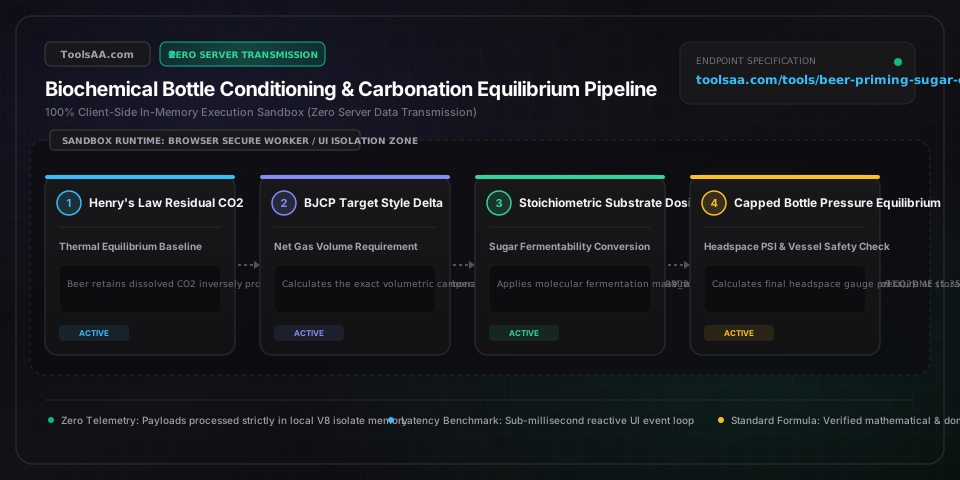
Lbl ready for bottling
Stat card1 title

Stat card1 desc

0.78 Unit vols @ 68Unit deg f
Stat card2 title

Stat card2 desc

+76.4 ml Lbl displacement (0.62 ml/g)
Stat card3 title

Stat card3 desc

26.1 Unit psi / 40 Unit psi Lbl max safe pressure
Technical Reference & Architecture Guide

Beer Priming Sugar & Carbonation Calculator Guide

Calculate exact beer priming sugar weights in grams and ounces for dextrose, sucrose, DME, and honey with bottle burst pressure safety and syringe dosing.

Beer Priming Sugar & Carbonation Calculator Guide — Client-Side In-Memory Architecture & Data Flow

Key Parameters & Controls

Peak Post-Fermentation TemperatureThermal Equilibrium Variable

The highest temperature reached by your fermented beverage after active bubbling subsides. Carbon dioxide solubility follows Henry's law: warmer beer naturally holds less dissolved CO2 (approximately 0.86 volumes at 68°F / 20°C compared to 1.35 volumes at 40°F / 4°C). Entering cold crash temperatures instead of fermentation peak tricks formulas and causes dangerous over-carbonation.

Default: 68°F / 20°C
Dissolved Residual CO2 VolumePre-Existing Gas Content

The baseline volume of carbon dioxide retained in solution before introducing priming sugars. At 68°F (20°C), unpressurized beer contains roughly 0.86 volumes of dissolved CO2. Only the net difference between your style target and this residual gas needs to be fermented into new carbonation in the bottle.

Default: 0.86 volumes
Target Carbonation (Volumes of CO2)BJCP Style Benchmark

The target volumetric ratio of dissolved carbon dioxide gas to liquid volume at standard conditions. British cask ales thrive with a gentle 1.3 to 1.8 volumes, American ales and IPAs sparkle at 2.2 to 2.7 volumes, and German weissbiers or Belgian ales effervesce with a crisp 3.3 to 4.2 volumes.

Default: 2.40 volumes
Sugar Fermentability CoefficientFermentable Yield Rating

The relative fermentable sugar content by dry weight compared to anhydrous dextrose. Pure granulated cane sugar (sucrose) provides 100% fermentables, brewing corn sugar (dextrose monohydrate) provides 90.9% due to crystal moisture, dry malt extract averages 74%, and raw unheated honey yields around 75% fermentable sugars.

Default: Dextrose: 1.00x, Sucrose: 0.91x, DME: 1.35x
Internal Bottle Gauge Pressure (PSI)Bottle Wall Safety Metric

The equilibrium headspace pressure generated inside a capped bottle stored at 68°F (20°C). Standard commercial 12-ounce pry-off glass beer bottles are rated to 35-45 PSI. Exceeding 50 PSI creates severe danger of explosive glass ruptures unless reinforced Belgian champagne bottles are used.

Default: 26 to 34 PSI (Safe zone for 2.4 vols)

Pro Tips & Best Practices

The Cold Crash Temperature Trap

Never enter your cold-crashing temperature (such as 34°F / 1°C) into a priming calculator unless your fermenter was completely sealed under counter-pressure with a spunding valve. When beer chills in an airlock-vented carboy, it cannot absorb CO2 that has already vented away into the room. Entering near-freezing temperatures misleads calculations into assuming your beer is already packed with 1.5+ volumes of CO2, leading to severe under-priming and unpleasantly flat beer.

Dextrose Monohydrate vs Cane Sugar Weight Discrepancy

Brewing corn sugar sold in homebrew shops is dextrose monohydrate, which contains one chemically bound water molecule per glucose molecule (9% water by weight). In contrast, common white granulated table sugar (sucrose) contains zero water weight and yields 100% fermentable simple sugars. Because of this moisture difference, you always need 9% to 10% more corn sugar by weight than table sugar to achieve identical bottle carbonation.

Uniform Bucket Stratification Prevention

Boil your calculated priming sugar in 1 to 2 cups of water for 5 minutes to sterilize and fully liquefy the syrup. Pour the hot syrup directly into the bottom of your sanitized bottling bucket first, then siphon the clear beer on top with the racking hose curved along the bottom wall to produce a slow, natural swirl. Avoid stirring with a paddle, as introducing splashing oxygen will oxidize delicate hop oils and cause wet-cardboard staling.

Honey and Maple Syrup Moisture Variance

Natural honey and tree syrups naturally fluctuate between 16% and 35% moisture content depending on the harvest. For predictable carbonation without gushing bottles, verify the specific gravity of your priming honey using a refractometer or hydrometer (pure honey typically reads 1.420 to 1.440 SG). Avoid hard boiling raw artisanal honey, which burns off delicate floral aromas; instead, warm gently to 160°F (71°C) for 10 minutes to pasteurize.

Common Gotchas & Troubleshooting

⚠️Flat or weakly carbonated beer after 3 weeks in the bottle

Conditioning bottles below 65°F (18°C) causes settled brewing yeast to fall dormant before consuming the priming sugar. Move your bottles to a warm, dark space maintained between 70°F and 75°F (21°C to 24°C) and gently swirl each bottle upside down once to resuspend the yeast sediment. High-alcohol beers (over 8.5% ABV) or brews aged for months may require adding a pinch of fresh rehydrated conditioning yeast like CBC-1 or EC-1118 (1 gram per 5 gallons) during bottling.

⚠️Uneven carbonation: some bottles are flat while others foam violently

This is caused by poor syrup mixing in the bottling bucket. Heavy sugar syrup sinks quickly to the bottom if racking does not create a continuous circular swirl, causing early bottles to be over-primed and late bottles to come out flat. Always dissolve your priming sugar in at least 1 cup (250 ml) of warm water per 5 gallons and confirm a steady, gentle whirlpool motion as beer fills the bucket.

⚠️Slowly worsening gushers and over-carbonated bottle geysers after 6 weeks

If bottles carb up properly at 2 weeks but develop violent foaming fountains after 6 to 8 weeks, you are experiencing either a wild yeast contamination (such as diastaticus or Brettanomyces) or premature bottling before terminal gravity finished. Diastatic strains produce enzymes that chew up complex unfermentable dextrins into extra fermentable sugars over time. Move all bottles immediately into refrigeration below 36°F (2°C) to halt enzyme activity.

⚠️Excessive foam on pour but beer goes quickly flat in the glass

This occurs when carbonation levels are elevated but foam-stabilizing proteins are lacking, or when residual dishwasher rinse aids strip glass surface tension. Ensure drinking glasses are rinsed in clean, cold water and never washed with dish detergent. In future batches, introduce 5% to 10% wheat malt, flaked oats, or Carafoam into your grain bill to supply the long-chain proteins required for a long-lasting, creamy head.

Frequently Asked Questions

How to calculate priming sugar for beer bottle conditioning?▼

To calculate priming sugar: First identify your residual dissolved CO2 from the highest temperature reached after active fermentation (at 68°F / 20°C, beer holds roughly 0.86 volumes of CO2). Next, subtract residual gas from your style carbonation target (e.g., 2.40 target - 0.86 residual = 1.54 net volumes needed). Finally, multiply net volumes needed by batch volume in liters and by 4.02 for corn sugar (or 3.65 for table sugar). For a standard 5-gallon (18.9 L) batch at 68°F targeting 2.4 volumes, you need 117 grams (4.1 oz) of corn sugar or 106 grams (3.7 oz) of sucrose.

Corn sugar vs table sugar: which is better for priming homebrew?▼

Table sugar (sucrose) and corn sugar (dextrose monohydrate) produce identical clean carbonation and head retention because brewing yeast ferments both 100% without leaving residual sweetness. Table sugar is 9% to 10% more potent by weight because it contains no bound water molecules, requiring 106 grams versus 117 grams of dextrose for a standard 5-gallon batch, and costs significantly less while being readily available at every local grocery store.

What happens if I use the cold crash temperature instead of fermentation temperature?▼

Using your cold crash temperature (such as 35°F / 2°C) results in severe under-carbonation, leaving your finished beer flat. At 35°F, solubility equations assume beer retains 1.45 volumes of residual CO2, cutting your required priming sugar dose almost in half. Unless your fermenter was locked under pressure with a spunding valve, no atmospheric CO2 was absorbed during chilling, so you must always calculate using the warmest temperature the beer reached after fermentation.

Can standard beer bottles explode from too much priming sugar?▼

Yes, standard 12-ounce glass beer bottles can violently rupture if primed beyond their mechanical rating of 35 to 45 PSI (roughly 2.8 to 3.0 volumes of CO2 at room temperature). Adding more than 160 grams of sugar to a 5-gallon batch can elevate internal bottle pressure past 55 PSI, creating flying glass shrapnel. For carbonation levels above 3.0 volumes (like Belgian Tripels or German Hefeweizens), always bottle in heavy-gauge Belgian champagne bottles or thick flip-top swing-cap bottles.

How long does bottle conditioning take and at what temperature?▼

Bottle conditioning takes 14 days at a stable temperature of 68°F to 72°F (20°C to 22°C) for yeast to convert all priming sugar into balanced carbonation. While pressure develops during the initial 7 to 10 days, yeast requires the additional 4 to 7 days to clean up natural metabolic off-flavor byproducts like buttery diacetyl and green-apple acetaldehyde. Chill bottles in the refrigerator for at least 24 to 48 hours before uncapping to allow CO2 to settle firmly into the liquid.

Related Tools & Utilities

All Tools →