/
Customs Duty Calculator & Import Tariff
US • FOB 2020Badge fob valuation

Hero title

Hero subtitle

Kpi net landed per unit$40.46
Kpi effective tariff28.07%
Lbl presets row
Tab calculator
Sec jurisdiction titleLbl incoterms standard
Sec invoice title
Sec tariff titleLbl hs preset note
Lbl vat registered importerLbl vat registered desc
Sec clearance title
Sec reverse budget title
Lbl valuation method: FOB (US/CA/AU)Lbl units count: 1000
Lbl total net landed cost
$40,460.35
Lbl net unit landed: $40.46
Lbl fob factory cost: $28,500.00+ $8,000.35 Lbl duties and fees badge+ $3,960.00 Lbl logistics and handling
Lbl cost breakdown share100% P&L Landed Share
FOB: 70.4%
Freight: 6.8%
Duty/Tariff: 19.8%
Clearance: 3.0%
Lbl itemized cost schedule
Col cost layerCol basisCol rateCol total amount
Row factory fob
1000 units @ $28.50
1000 pcs$28.50/pc$28,500.00
Row intl freight
ocean_fcl mode
Carrier Quote-$2,600.00
Row cargo insurance
Underwriter policy
ICC (A) / Air-$140.00
Row dutiable baseFOB Formula = Factory Transaction ValueFOB Basis-$28,500.00
Row standard duty
Assessed on dutiable valuation base
$28,500.002.6%$741.00
Row section301
US-China Trade Act punitive assessment
$28,500.0025%$7,125.00
Row cbp fees
MPF $98.72 + HMF $35.63
CBP Border0.3464% / 0.125%$134.35
Row import tax
100% Tax Credit Reclaimable (Excluded from net)
$36,366.000%$0.00
Row domestic handling
Broker $150.00 + Port $320.00 + Inland $750.00
Warehouse Delivery-$1,220.00
Row total net landed1000 units$40.46/pc$40,460.35
Lbl gross outlay header
$40,460.35
Lbl gross outlay: $40,460.35
Lbl effective tariff rate
28.07%
Lbl inflation multiplier: 1.42x
Lbl formal entry requiredLbl threshold: $800.00
Lbl target margin ok
Lbl wto sub ms sandboxed
Lbl total commercial value
$28,500.00
1000 units @ $28.50
Lbl total border duties
$8,000.35
Lbl standard duty tariff fees
Lbl net unit landed
$40.46
Lbl landed inflation multiplier 1.42x

Client-Side Processing

High-performance calculation executed entirely in browser memory.

Zero Server Upload Privacy

All payloads remain strictly local with zero external server communication.

Production Ready Export

Clean, optimized output formats ready for immediate deployment.

Disclaimer text
Technical Reference & Architecture Guide

Customs Duty Calculator & Import Tariff Guide

Calculate exact customs duty, import tariff, VAT/GST, and landed cost for US, EU, UK, and CA. Includes FOB vs CIF rules, de minimis limits, and Section 301 fees.

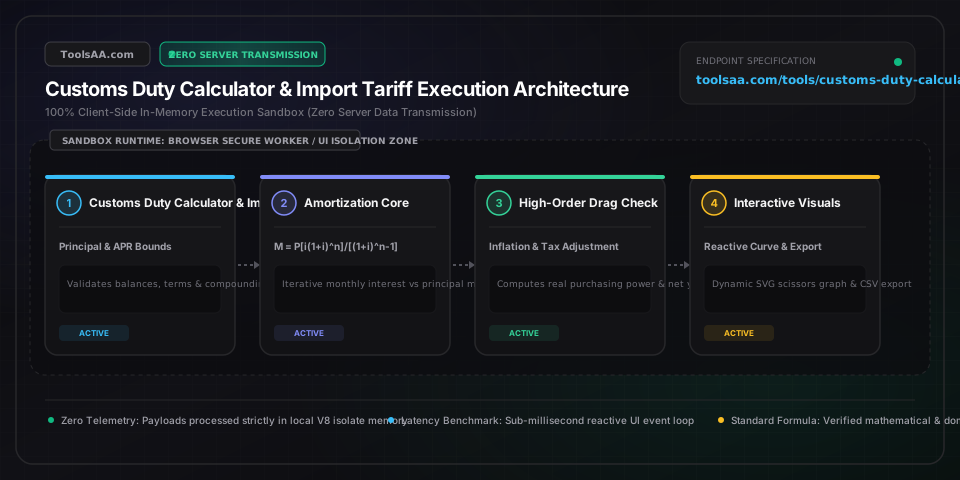
Customs Duty Calculator & Import Tariff Guide — Client-Side In-Memory Architecture & Data Flow

Key Parameters & Controls

Commercial Invoice FOB ValueTransaction Valuation Basis

The net transaction value of merchandise under WTO Customs Valuation Agreement Art. 1, reflecting price actually paid or payable ex-foreign port. Forms the mandatory dutiable baseline for United States (19 CFR § 152.103), Canadian (Customs Act s. 48), and Australian imports, determining formal entry thresholds ($2,500 US / CAD $3,300 CA) and statutory de minimis qualification.

Default: 12500.00
Statutory HTS Ad Valorem Duty RateTariff Schedule Percentage

Baseline Most-Favored-Nation (MFN) tariff percentage published in national schedules (USITC HTSUS, EU TARIC, UK Integrated Tariff). Benchmarks range from 0.0% for Information Technology Agreement (ITA) computing hardware to 32.0%+ for woven synthetic garments and compound tariff footwear.

Default: 5.5%
International Freight & Marine Cargo InsuranceLanded Carriage Cost

Total ocean bill of lading, air freight carriage, and marine transit insurance costs to destination border. Fully dutiable under CIF regimes (EU Union Customs Code Art. 70-71 and UK HMRC) and added directly into the Value of Taxable Importation (VoTI) for Australian GST assessment.

Default: 1850.00
US Section 301 / Trade Remedy SurchargeTrade Defense Duty Rate

Statutory retaliatory duty levied under Section 301 of the Trade Act of 1974 on Chinese-origin commodities (ranging from 7.5% on List 4A to 25.0% on Lists 1, 2, and 3) or Section 232 steel/aluminum duties (25%/10%). Computed strictly on FOB transaction value on top of standard MFN tariffs.

Default: 25.0%
Destination Import VAT / GST RateCascading Indirect Tax Rate

Border consumption tax assessed on the cascading sum of (CIF Customs Value + Customs Duty + Mandatory Port/Handling Charges) in the UK (20.0%) and EU (17.0%-27.0%), or against statutory VoTI in Australia (10.0%). Fully recoverable as input tax credit by VAT-registered corporate importers.

Default: 20.0%

Pro Tips & Best Practices

Incoterms DDP vs. DAP Structural Cash Flow Inefficiency

Procuring goods under DDP (Delivered Duty Paid) forces foreign suppliers to finance destination VAT and duties. Because non-resident suppliers cannot easily recover import VAT without local tax establishment, they incorporate a 20% to 30% margin buffer into product prices. Transitioning procurement contracts to DAP (Delivered at Place) allows domestic corporate importers of record to pay import VAT directly and reclaim 100% as an input tax credit on quarterly tax filings.

Statutory 'Assists' Omission Triggers 19 U.S.C. § 1592 Penalties

Providing overseas manufacturers with free or discounted tooling, injection molds, engineering dies, specialized CAD designs, or production materials constitutes a statutory 'customs assist' under 19 CFR § 152.102. Importers are legally obligated to apportion and declare assist values onto commercial invoices. Omitting assists understates the transaction value, exposing the importer to retroactive duty clawbacks, statutory interest, and fraud/gross negligence penalties under 19 U.S.C. § 1592.

First Sale Rule Arbitrage in Multi-Tier Sourcing

In multi-tier transactions involving an offshore manufacturer, an intermediary trading house, and a domestic buyer, US importers can legally assess customs duty on the lower 'First Sale' price (manufacturer-to-vendor) rather than the markup-inflated vendor-to-importer price. Qualifying under CBP First Sale jurisprudence requires verifiable proof of arm's length pricing, non-contingent sales contracts, and clear proof that goods were destined for the United States at the moment of initial sale.

Substantial Transformation Traps Under Section 301 Rulings

Rerouting Chinese raw materials or assemblies through third-party countries (such as Vietnam, Mexico, or Malaysia) for minor packaging, superficial soldering, or final testing does not confer third-country origin under CBP 19 CFR Part 102. Unless goods undergo a genuine 'substantial transformation' resulting in a distinct new name, character, and commercial use supported by a formal CBP ruling, US customs will retroactively assess 25% Section 301 duties plus late deposit penalties.

Common Gotchas & Troubleshooting

⚠️Receipt of CBP Form 28 (Request for Information) or Form 29 (Notice of Action) for Tariff Reclassification

Immediately audit the declared 10-digit HTS code against General Rules of Interpretation (GRI 1-6) and precedent rulings in the Customs Rulings Online Search System (CROSS). Submit certified technical datasheets, material breakdown percentages by weight and value, and operational flowcharts proving the product's 'essential character' under GRI 3(b) within 30 days. Ignoring or failing Form 28 triggers a formal Form 29 Rate Advance, escalating liquidation rates retroactively across all unliquidated entries.

⚠️Shipment Detained at European or UK Border for Understated Single Administrative Document (SAD) Box 47 Tax Base

Audit the declared Box 47 customs worksheet. Under EU Union Customs Code (UCC) Art. 70-71 and UK HMRC regulations, import VAT cannot be calculated on bare invoice price. The statutory VAT base equals CIF Customs Value + Customs Duty + Incidental Inland Transport to destination. Submit revised commercial invoices with certified air waybills/ocean bills of lading through the Customs Declaration Service (CDS) or ATLAS system to pay the variance and prevent container demurrage accrual.

⚠️Customs De Minimis Denial and Forfeiture Due to Same-Day Conveyance Manifest Aggregation

U.S. CBP strictly enforces 19 CFR § 10.151, prohibiting individual consignees from receiving more than one Section 321 ($800 limit) duty-free shipment per day on a single carrier manifest. When multiple parcel shipments to the same buyer arrive concurrently on one aircraft or vessel, CBP aggregates their cumulative transaction value. If the total exceeds $800, file an emergency Type 01 formal or Type 11 informal entry, pay the statutory MPF ($31.67 minimum), and declare standard HTS duties to release the hold.

Frequently Asked Questions

How is customs duty calculated on imported goods?▼

Customs duty is calculated by applying the statutory tariff rate from a country's Harmonized Tariff Schedule (HTS) to the dutiable customs value of the merchandise. The exact formula depends on whether the destination country uses FOB (Free On Board) or CIF (Cost, Insurance, and Freight) valuation. Under FOB valuation (used by the United States, Australia, and Canada), Customs Duty = FOB Commercial Value × Ad Valorem Duty Rate %. Under CIF valuation (used by the European Union, United Kingdom, and Japan), Customs Duty = (Commercial Value + International Freight + Marine Insurance) × Ad Valorem Duty Rate %. If specific duties apply (e.g. per pair of shoes or kilogram), duty is calculated as Quantity × Specific Rate.

What is the difference between FOB and CIF valuation for customs?▼

The critical difference lies in whether international transportation and cargo insurance costs are taxed at the border. Under FOB (Free On Board) valuation, customs authorities (such as U.S. CBP or Australia ABF) legally exclude overseas ocean/air freight and marine insurance from the dutiable base. You only pay customs duty on the factory purchase price of the merchandise. Under CIF (Cost, Insurance, Freight) valuation, customs authorities (such as the EU UCC or UK HMRC) mandate that duty be assessed on the cumulative total of product price, shipping charges, and transit insurance to the destination border. Consequently, importing identical goods into a CIF regime results in higher duty and higher import VAT than under an FOB regime.

What are de minimis thresholds and how do they exempt duty?▼

A de minimis threshold is a statutory monetary value below which imported commercial goods enter a country completely exempt from customs duties, formal customs declarations, or both. In the United States, under Tariff Act Section 321, shipments with a fair retail value up to $800 USD enter duty-free and tax-free for individual informal entries. In the European Union, goods with an intrinsic value up to €150 are exempt from customs duty, although 100% of commercial imports remain subject to Import VAT (since the July 2021 abolition of the €22 VAT de minimis). In the UK, the duty-free threshold is £135. In Australia, the customs de minimis is AUD $1,000. Consignments that exceed these limits are subject to formal entry clearance, full duty assessments, and administrative processing fees.

How do US Section 301 China tariffs and MPF/HMF fees apply?▼

Goods manufactured in China and imported into the United States are subject to punitive tariffs under Section 301 of the Trade Act of 1974. These tariffs range from 7.5% (List 4A) to 25.0% (Lists 1, 2, and 3), assessed in addition to standard MFN customs duty. Furthermore, commercial shipments to the U.S. trigger two statutory port fees: the Merchandise Processing Fee (MPF), assessed at 0.3464% of FOB value for formal entries (minimum $31.67, maximum $614.35); and the Harbor Maintenance Fee (HMF), assessed at 0.125% of commercial cargo value exclusively for ocean maritime freight unloading at commercial U.S. ports. Air shipments and entries under $800 de minimis are exempt from both MPF and HMF.

Can you claim zero customs duty with a Free Trade Agreement (FTA)?▼

Yes, but zero duty is not automatic simply because a product is shipped from an FTA member country. To legally qualify for preferential 0% customs duty under agreements like the USMCA (United States-Mexico-Canada Agreement) or the UK-EU Trade and Cooperation Agreement (TCA), the merchandise must satisfy specific Rules of Origin (ROO). The product must either be wholly obtained in the member nation or have undergone a prescribed tariff shift and meet Regional Value Content (RVC) percentages. The importer of record must possess an official, signed Certificate of Origin from the manufacturer before declaring preferential treatment on customs entry documents.

How is import VAT or GST calculated on top of customs duty?▼

Disclaimer: This tool is provided strictly for educational and informational purposes only and does not constitute formal financial advice or a binding loan commitment. Please consult a qualified financial advisor before making decisions. Import VAT or GST is calculated on a cascading tax base rather than the raw invoice price. In CIF regimes like the UK and EU, the taxable basis for import VAT is: Import VAT = (CIF Value + Customs Duty Owed + Mandatory Port/Excise Fees) × VAT Rate %. This means you pay Value Added Tax on the customs duty itself. In Australia, GST is charged at 10% on the Value of Taxable Importation (VoTI), which equals FOB Customs Value + Customs Duty + International Transport and Insurance. Registered VAT/GST businesses can typically reclaim this import tax as input tax credit on their regular tax filings, whereas retail consumers absorb it as a sunk cost.

Related Tools & Utilities

All Tools →
Cap Rate Calculator & Real Estate NOIfinance

Institutional-grade real estate cap rate and NOI valuation calculator for commercial and residential properties. Features itemized pro-forma operating expense ledgers, reverse target acquisition solvers, mortgage debt leverage metrics (Cash-on-Cash, DSCR, break-even occupancy), dynamic 2D price-to-yield sensitivity matrices, and one-click PDF/Excel deal exports.

Open tool→
ROAS Calculator & Break-Even Target ROASfinance

Calculate ROAS, break-even target ROAS, and net ad profit instantly. Model ad spend, gross margin, blended CAC, and required conversion rates for eCommerce ROI.

Open tool→
Pallet Stacking & Ti-Hi Pattern Calculatorlogistics

Interactive Pallet Stacking Calculator & Ti-Hi Pattern with real-time client-side analysis and visualization.

Open tool→
Sonotube Calculator & Concrete Pier BagsUtility

Calculate concrete volume in cubic yards, cubic feet, and 40, 50, 60, or 80 lb bags for Sonotube cardboard forms, flared footings, and rebar cages.

Open tool→
Tap Drill Size Calculator & Thread Chartengineering

Calculate exact pre-tapping hole diameters for Metric ISO (M1–M68) and Unified Imperial (UNC, UNF, UNEF #0–2") threads across cutting taps and cold-forming roll taps, with adjustable Percent of Thread (% engagement), material recommendations, and nearest fractional/letter/number/metric drill bit snapping.

Open tool→
Steps per mm Calculator & E-StepsUtility

Calculate theoretical and measured steps per mm, steps per inch, or Klipper rotation distance for 3D printers and CNCs. Calibrate GT2 belts, T8 leadscrews, ballscrews, and geared E-steps.

Open tool→