Pallet Stacking & Ti-Hi Pattern Calculator

Pallet Stacking & Ti-Hi Pattern Calculator

Badge iso standard

Interactive Pallet Stacking Calculator & Ti-Hi Pattern with real-time client-side analysis and visualization.

Lbl quick presets
Title parameters cockpit
Lbl carton specsUnit in / Unit lb
Lbl pallet base specs
Lbl stack limits and rules
Lbl reverse planning title
Lbl geometry validLbl ti hi short: 8 × 5 = 40
Lbl ti cartons: 8Lbl area efficiency: 81.5%
12345678
Lbl complexity statusLbl area: 81.5% | Lbl gross: 1,022 Unit lb
Stat area cube title81.5% / 81.5%
Stat total units title40 Unit cartons (8 Lbl ti × 5 Lbl hi)
Stat gross weight title1,022 Unit lb

Client-Side Processing

High-performance calculation executed entirely in browser memory.

Zero Server Upload Privacy

All payloads remain strictly local with zero external server communication.

Production Ready Export

Clean, optimized output formats ready for immediate deployment.

Disclaimer text

Technical Reference & Architecture Guide

Pallet Stacking & Ti-Hi Pattern Calculator Guide

Interactive Pallet Stacking Calculator & Ti-Hi Pattern with real-time client-side analysis and visualization.

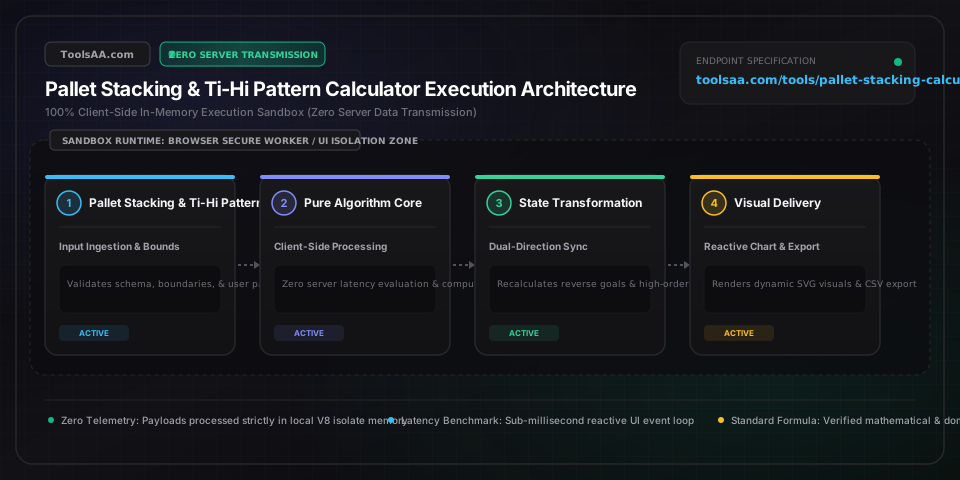
Pallet Stacking & Ti-Hi Pattern Calculator Guide — Client-Side In-Memory Architecture & Data Flow

Key Parameters & Controls

palletStandardSpecISO / GMA / EPAL Platform Standard

Standardized pallet deck boundary selecting between GMA Spec 1A (1219 × 1016 mm / 48 × 40 in; 2,800 lb dynamic load rating per ISO 6780), EUR 1 / EPAL 1 (1200 × 800 mm / 47.2 × 31.5 in; 1,500 kg dynamic), EUR 2 / UK Standard (1200 × 1000 mm), ISO Ocean Container (1140 × 1140 mm), and Australian AS 4068 (1165 × 1165 mm). Establishes horizontal footprint boundaries, stringer or block positioning, and tare weight baseline.

Default: GMA Spec 1A (48.0 × 40.0 in)
cartonOuterDimensionsOuter Boundary (Length × Width × Height)

External three-dimensional coordinates (OD) of the primary corrugated container measured to ISTA 3A precision. Must incorporate a 0.125 in (3.175 mm) score-line bulging tolerance per side to prevent carton expansion collisions against storage racking beams.

Default: 16.0 × 12.0 × 10.0 in (406 × 305 × 254 mm)
grossCartonWeightPayload Mass per Secondary Pack

Individual gross case mass inclusive of internal product, protective dunnage, and corrugated tare weight. Calibrated against ASTM D642 top-to-bottom compression limits and OSHA/ISO ergonomic manual lifting guidelines (50 lb / 23 kg threshold per single worker).

Default: 25.0 lbs (11.34 kg)
maxStackHeightClearanceVertical Clearance Envelope

Maximum allowable vertical unit load dimension including pallet base tare height (5.5 in / 140 mm for GMA stringer pallets; 5.7 in / 144 mm for EPAL 1). Standard logistics thresholds mandate 52.0 in (1320 mm) for double-stacking inside standard 110-inch dry vans, 65.0 in (1651 mm) for automated high-bay conveyor clearance, or 84.0 in (2133 mm) for intermodal ocean high-cube containers.

Default: 65.0 in (1651 mm)
overhangToleranceLimitPerimeter Linear Dimension

Maximum permissible horizontal protrusion of cartons beyond the outer edge of the pallet deck. High-bay AS/RS cranes and selective drive-in racks mandate exactly 0.0 in (0.0 mm) to avoid beam optical sensor faults; general LTL road carriage tolerates up to 0.5 in (12.7 mm) at a mandatory 32% reduction penalty to carton compressive safety factors.

Default: 0.0 in (0.0 mm)
stackingPatternTypeTessellation Configuration Mode

Selects between Column Stack (aligned corner posts maintaining 100% of laboratory McKee Box Compression Test strength, zero shear interlock) and Interlocking / Pinwheel Brick Pattern (cross-rotated tiers providing high transit shear friction, but derating effective vertical BCT by 30% to 45% due to middle-flap point loading).

Default: Interlocked (Cross-Stacked)
Pro Tips & Best Practices

Compensate for the 32% Corner-Overhang Structural Degradation Cliff

Corrugated fiberboard containers derive approximately 65% of their total axial load-bearing capacity directly from their four vertical corner scorelines. Allowing as little as 0.5 inches (12.7 mm) of perimeter overhang past the pallet deck leaves two corner posts hanging in cantilever without direct vertical support. This induces an immediate 32% drop in bottom-tier compressive strength under ASTM D642 dynamic testing, leading to creasing and premature unit load failure during highway transit.

Apply Humidity Derating Factors to Laboratory McKee BCT Calculations

Nominal Box Compression Test (BCT) values established in laboratory environments (50% RH at 23°C / 73°F per ASTM D685) degrade non-linearly under maritime and cold-chain staging conditions. At 80% relative humidity, corrugated fiberboard absorbs moisture and loses 48% to 55% of its compressive structural rigidity. When calculating maximum Hi tiers for intermodal ocean containers or refrigerated freight, multiply the baseline McKee calculated load by an environmental derating safety factor between 3.5 and 5.0.

Account for Dynamic Carton Bulge to Prevent High-Bay AS/RS Rejections

Under ASTM D4649 stretch-wrap containment forces (>15 lbf) and prolonged static stacking pressure, carton side panels deflect outward by 0.125 to 0.25 inches (3.175 to 6.35 mm) per unit. Across a four-box Ti configuration, cumulative bulge adds 1.0 to 1.5 inches of footprint width. In automated storage and retrieval systems (AS/RS), this lateral expansion breaches the allowable rack tolerance and trips photoelectric light curtains at the receiving induct station, causing automated reject routing.

Client-Side O(n) Guillotine Tessellation with Zero Network Data Exposure

ToolsAA executes 2D orthogonal bin-packing and pinwheel pattern heuristics entirely client-side inside the browser's JavaScript execution sandbox using an O(n) guillotine cutting-stock optimization matrix. Proprietary SKU dimensions, bill-of-lading cargo values, and packaging geometries are computed in local volatile memory without transmission across external network sockets or third-party analytical endpoints, guaranteeing strict confidentiality for corporate logistics manifests.

Common Gotchas & Troubleshooting

⚠️Bottom-tier boxes crush during highway transit despite total cargo weight falling 600 lbs below the pallet's dynamic payload limit.

Evaluate carton stacking alignment and pallet top-deck gap spacing. Switching from a column pattern to an interlocking (brick/pinwheel) pattern rotates upper carton corners onto the center top flaps of bottom boxes, cutting compression resistance by 30% to 45%. Additionally, wooden GMA pallets with top-deck gaps exceeding 3.5 inches allow carton bottoms to bow inward. Remedy this by returning to column stacking and inserting 0.020-inch solid fiberboard slip sheets or 200-lb test corrugated tier pads between tiers 1 and 2 to distribute point loads across pallet stringers.

⚠️Unit load layout shows zero overhang in calculator software, but pallets are rejected by warehouse AS/RS optical profiling sensors.

Incorporate wooden pallet manufacturing variances, stretch wrap tails, and hygroscopic fiberboard expansion into your input dimensions. Certified GMA spec pallets carry an allowable manufacturing tolerance of ±0.25 in (±6.35 mm). When 80-gauge stretch wrap wraps the perimeter (adding ~0.125 in per side) and ambient warehouse humidity expands carton walls by 2%, a nominal 48.0 × 40.0 in load reaches 48.75 × 40.5 in. Recompute your Ti pattern with a negative 0.5-inch (12.7 mm) clearance buffer (effective boundary 47.5 × 39.5 in).

⚠️Trailer reaches legal maximum highway axle weight limit before its interior cubic volume is fully occupied (weighing out before cubing out).

Balance axle weight distributions in compliance with the Federal Bridge Gross Weight Formula (23 CFR § 658.17). A standard 53ft dry van is limited to 45,000 lbs cargo payload to stay within the 80,000 lb gross vehicle weight cap across steer, drive, and tandem axle groups. If your Ti-Hi combination yields 26 pallets at 1,900 lbs each (49,400 lbs total), drop Hi by one tier (e.g., from 6 high to 5 high), or load high-density unit loads turned (pinwheeled) across the center trailer floor while staging lower-tier pallets over the tractor drive and trailer tandem axles.

Frequently Asked Questions

How do you calculate Ti-Hi on a pallet?▼

Calculate Ti-Hi by multiplying the tier carton count (Ti, boxes per layer) by the vertical layer count (Hi, number of stacked tiers): Total Cartons = Ti × Hi. Ti is derived by testing orthogonal 2D bounding-box tessellations (carton length and width aligned parallel, perpendicular, or pinwheeled against pallet dimensions) up to allowable overhang limits. Hi is calculated using the limiting factor between clearance height [floor((Max_Clearance_Height - Pallet_Tare_Height) / Box_Height)] and maximum structural payload weight [floor(Max_Pallet_Payload / (Ti × Box_Gross_Weight))].

How many GMA 48x40 pallets fit in a 53ft trailer versus a 40ft container?▼

A standard 53ft domestic dry van trailer accommodates 26 single-stacked GMA 48×40 pallets loaded straight (two wide by 13 deep), or up to 30 pallets when turned (pinwheeled: one pallet straight and one turned per row across a 100-inch interior width). If total pallet height is under 52 inches and cargo mass permits, double-stacking allows 52 to 60 pallets. In contrast, an ISO 40ft ocean container (92.5-inch interior width) fits only 20 single-stacked GMA 48×40 pallets, or 21 pallets if pinwheeled, due to narrower sidewall constraints.

Column stacking vs interlocking pallet patterns: which is stronger?▼

Column stacking is 30% to 45% stronger in vertical compression than interlocking stacking because it aligns all four vertical corner posts directly on top of each other from top tier to bottom pallet deck. However, column stacks have zero interlocking mechanical friction and are prone to shifting or toppling during transport unless bound by high containment force stretch film (ASTM D4649) or vertical strapping. Interlocking (brick) stacking enhances horizontal transit stability by staggering joints, but concentrates corner post point loads on the weaker center flaps of lower boxes, substantially reducing overall load-bearing capacity.

How much pallet overhang is allowed in warehouse racking and transit?▼

Automated warehouse storage systems (AS/RS) and drive-in pallet racking mandate 0.0 inches (0.0 mm) of overhang; even a 0.25-inch protrusion can trip optical profiling sensors or snag upright structural rack columns. For standard truckload (FTL) and less-than-truckload (LTL) road freight, up to 0.5 inches (12.7 mm) of overhang is commercially tolerated, but unsupported box corners reduce bottom-tier carton compression strength by up to 32%, sharply raising transit damage claims.

How do you calculate box compression strength using the McKee formula for pallet stacks?▼

The simplified McKee formula estimates corrugated Box Compression Test (BCT) strength as BCT = 5.87 × ECT × sqrt(T × Perimeter), where ECT is Edge Crush Test in lb/in, T is corrugated caliper board thickness in inches, and Perimeter equals 2 × (Box_Length + Box_Width). To determine the maximum allowable static load on the bottom carton in a pallet stack, divide BCT by an operational safety factor between 3.0 (for short-duration clean warehouse storage) and 5.0 to 8.0 (for dynamic ocean transit under high ambient humidity and prolonged warehouse dwell).

What is the maximum weight capacity for standard GMA and Euro pallets?▼

A certified GMA Spec 1A 48×40 inch hardwood pallet has a dynamic payload capacity of 2,800 lbs (1,270 kg) during forklift transport and a static racking load limit of 4,500 lbs (2,041 kg). A standard EUR 1 / EPAL wooden pallet (1200 × 800 mm) has a dynamic load capacity of 1,500 kg (3,300 lbs) and a maximum static load of 4,000 kg (8,800 lbs) when supported by a level, uniform surface per European Standard EN 13698-1.

Related Tools & Utilities

All Tools →
Sonotube Calculator & Concrete Pier BagsUtility

Calculate concrete volume in cubic yards, cubic feet, and 40, 50, 60, or 80 lb bags for Sonotube cardboard forms, flared footings, and rebar cages.

Open tool→
Tap Drill Size Calculator & Thread Chartengineering

Calculate exact pre-tapping hole diameters for Metric ISO (M1–M68) and Unified Imperial (UNC, UNF, UNEF #0–2") threads across cutting taps and cold-forming roll taps, with adjustable Percent of Thread (% engagement), material recommendations, and nearest fractional/letter/number/metric drill bit snapping.

Open tool→
Steps per mm Calculator & E-StepsUtility

Calculate theoretical and measured steps per mm, steps per inch, or Klipper rotation distance for 3D printers and CNCs. Calibrate GT2 belts, T8 leadscrews, ballscrews, and geared E-steps.

Open tool→
Stair Carpet & Runner Yardage CalculatorUtility

Calculate exact stair carpet linear feet, square yards, and runner rolls for straight or landing flights. Compares Hollywood wrap vs waterfall styles with cut waste.

Open tool→
Fondant Coverage Calculator & Cake TierUtility

Calculate exact fondant weight, rolled circle diameter, and commercial pack requirements for round, square, and tiered cakes with zero cracking or waste.

Open tool→
Vegetable Garden Yield Calculator & PlannerUtility

Comprehensive vegetable garden harvest calculator for home gardeners, homesteaders, and self-sufficiency planners. Estimates total yield in pounds and kilograms across 30+ crops, family servings, required raised bed area, and nutritional calories.

Open tool→