Short title

Pipe Insulation & Heat Loss Calculator

Calculate pipe insulation thickness, heat loss, and annual energy savings across copper, PEX, and steel pipes. Prevent condensation and freeze damage accurately.

Lbl presets bar

Hdr pipe spec

ASTM B88 / A53
0.875"22.2 mm
Lbl pipe run length60 Unit ft
Lbl fluid temp140 Unit deg f
Range chilled brineRange dhwRange steam
Lbl ambient temp65 Unit deg f
Lbl relative humidity50%

Hdr insulation spec

ISO 12241 / ASTM C585
Lbl insulation thickness0.5 Unit in

Hdr economics

Lbl system efficiency
Lbl operating hours
Lbl installed cost

Hdr target solver

Solver desc

Kpi heat loss reduction
75.4%
10.7 Lbl vs 43.5 Unit btu ft
Kpi surface temp
77.6Unit deg f
Badge safe touch
Kpi annual savings
$253
0.8 Unit yr payback
Kpi condensation freeze
+31.7Unit deg f
Badge protected
Lbl visualizer explLbl scale
140Unit deg f77.6Unit deg f
Lbl core fluid
Lbl pipe wall
Lbl insulation collar
Lbl outer jacket
Lbl engine tag
Stat annual saved
$2,324
Stat carbon avoided
2,016 Unit lbs co2 year
Stat condensation safety
+31.7Unit deg f Lbl safety buffer suffix

Client-Side Processing

High-performance calculation executed entirely in browser memory.

Zero Server Upload Privacy

All payloads remain strictly local with zero external server communication.

Production Ready Export

Clean, optimized output formats ready for immediate deployment.
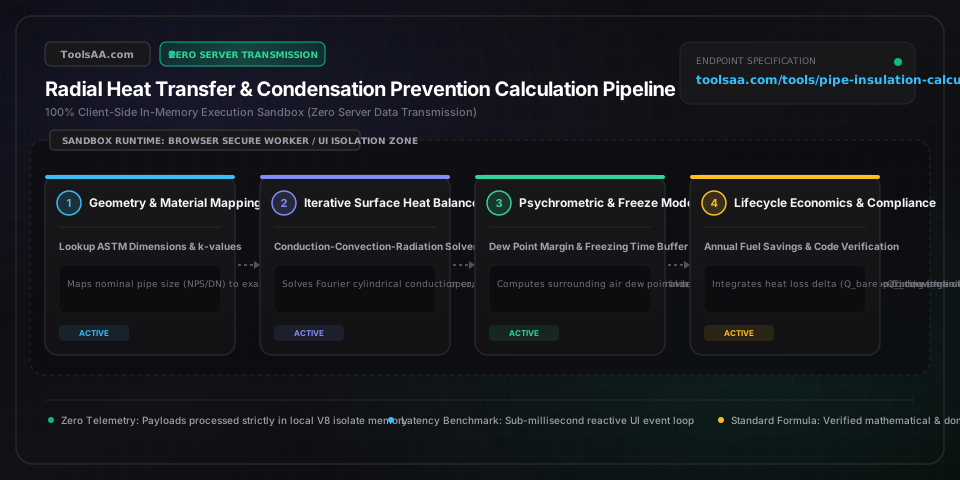
Technical Reference & Architecture Guide

Pipe Insulation & Heat Loss Calculator Guide

Calculate pipe insulation thickness, heat loss, and annual energy savings across copper, PEX, and steel pipes. Prevent condensation and freeze damage accurately.

Pipe Insulation & Heat Loss Calculator Guide — Client-Side In-Memory Architecture & Data Flow

Key Parameters & Controls

Nominal Pipe Size (NPS / DN Outer Diameter)Standard Pipe Dimension (Inches / Millimeters)

Standardized outer diameter conforming to ASTM B88 (Copper), ASTM A53 (Steel), or ASTM F876 (PEX). External surface area scales directly with outer diameter, dictating bare thermal radiation and convection boundaries.

Default: 1.0 in (NPS)
Operating Fluid Temperature (T_fluid)Process Temperature (°F / °C)

Continuous interior bulk fluid temperature. Typical benchmark values: 40°F to 45°F (chilled water), 120°F to 140°F (domestic hot water), 180°F to 200°F (hydronic heating), 212°F to 350°F+ (low/medium pressure steam).

Default: 140°F
Ambient Temperature & Relative Humidity (RH%)Surrounding Environment (°F / °C and %)

Surrounding still-air conditions. Higher ambient relative humidity dramatically elevates the dew point temperature, necessitating thicker insulation collars to avert surface condensation.

Default: 65°F / 50% RH
Insulation Apparent Thermal Conductivity (k-value)Thermal Conductivity (BTU·in/hr·ft²·°F or W/m·K)

Material heat conduction rate measured per ASTM C177/C518 at 75°F mean temperature. Lower k indicates superior thermal resistance. Fiberglass (~0.25), Elastomeric (~0.27), Calcium Silicate (~0.40).

Default: 0.26 BTU·in/hr·ft²·°F
Jacket Surface Emittance (epsilon)Radiative Emissivity (Dimensionless 0.05 to 0.95)

Radiation exchange factor of the exterior cladding. Non-metallic white ASJ paper or PVC jacket exhibits high emissivity (~0.90), while unpainted embossed aluminum (~0.20) or polished stainless steel (~0.05) restricts radiant emission.

Default: 0.90 (ASJ / PVC)
Energy Tariff & System Heating EfficiencyFinancial Unit Cost & Plant COP/AFUE

Blended marginal cost per therm ($/therm), kilowatt-hour ($/kWh), or gallon, coupled with boiler annual fuel utilization efficiency (AFUE 80% to 96%) or chiller COP (3.0 to 6.0) to model true converted fuel cost.

Default: $1.20/therm @ 85% AFUE

Pro Tips & Best Practices

Beware the Critical Radius Paradox on Small-Diameter Tubing

For small pipes (under 1/2-inch OD), applying a very thin layer of high-conductivity insulation can paradoxically increase total heat loss. When the insulation outer radius r_ins is less than the critical radius (r_crit = k_ins / h_outer), the added external convective surface area outpaces the conductive resistance gain. Always specify at least 0.5-inch (13 mm) thickness to guarantee operation past r_crit.

Vapor Retarder Integrity Dictates Cold Pipe Lifespan

On chilled water (40°F) or refrigeration lines, moisture vapor travels inward toward the cold pipe surface. If open-cell fiberglass lacks an impervious, 100% factory-sealed vapor barrier (permeance <= 0.02 perms), atmospheric moisture will permeate and condense inside the insulation. Wet fiberglass has a k-value up to 15x worse than dry insulation, causing catastrophic rot and dripping. Use closed-cell elastomeric foam or continuous zero-perm vapor-barrier jackets.

Uninsulated Pipe Hangers act as Major Thermal Bridges

Supporting insulated pipe directly with bare steel clevis hangers touching the pipe wall creates severe thermal short circuits. In domestic heating loops, uninsulated pipe supports degrade total system thermal resistance by 15% to 25%. On chilled water lines, uninsulated hangers instantly sweat and drip. Always install high-density calcium silicate or polyurethane insulation shields with continuous vapor seals at all support points.

Insulation Only Delays Freezing—It Cannot Prevent It Indefinitely

Without continuous water movement or supplemental electric heat trace cables, stagnant water in an unheated space will eventually freeze regardless of insulation thickness. 1-inch insulation typically extends the freeze buffer of a 1-inch pipe at 15°F from 1.5 hours to approximately 9 hours. For seasonal or long shutdowns, active heat tracing or complete drainage is mandatory.

Common Gotchas & Troubleshooting

⚠️Outer Jacket Sweats or Drips Despite Brand New Insulation

The outer surface temperature remains below the surrounding air's dew point. This occurs when ambient humidity exceeds design assumptions (e.g., 85% RH in summer unconditioned basements) or the jacket emissivity is low (aluminum cladding runs colder than PVC). Increase insulation thickness by 0.5 inches or switch to a high-emittance outer wrap (epsilon >= 0.90) to elevate surface temperature above dew point.

⚠️Calculated Energy Savings Do Not Match Utility Bill Reductions

Ensure operating hours and boiler efficiency are configured realistically. Continuous recirculation loops run 8,760 hours/year, whereas space heating hydronics operate only 2,000 to 3,500 hours during the winter heating season. Furthermore, heat lost into conditioned living spaces partially offsets winter room heating loads, reducing net building-envelope thermal waste.

⚠️Surface Temperature Exceeds OSHA Safe Touch Safety Limits (140°F / 60°C)

OSHA guidance stipulates that bare metal or jacket surfaces accessible to personnel must remain below 140°F (60°C) to prevent contact burns. On high-temperature steam (250°F+), if the calculated outer surface temperature exceeds 140°F, increase insulation thickness or upgrade from standard fiberglass to high-temperature calcium silicate or double-layer mineral wool.

Frequently Asked Questions

How do you calculate heat loss from an insulated pipe?▼

Heat loss per linear foot (or meter) is calculated using radial Fourier conduction combined with outer convection and radiation: Q/L = 2 * pi * (T_fluid - T_ambient) / [ ln(D_ins / D_pipe) / k_ins + 2 / (D_ins * h_outer) ]. D_pipe is the pipe outer diameter, D_ins is the insulation outer diameter, k_ins is thermal conductivity (typically 0.25 to 0.28 BTU·in/hr·ft²·°F for fiberglass/elastomeric), and h_outer is the combined surface heat transfer coefficient (~1.5 to 2.2 BTU/hr·ft²·°F under still indoor air conditions).

What thickness of pipe insulation is needed to prevent condensation?▼

Condensation prevention requires the exterior insulation jacket temperature (T_surface) to exceed the ambient dew point (T_dew). For standard 42°F (5.5°C) chilled water in an 85°F (29.4°C) mechanical room at 70% relative humidity (dew point ~74°F), minimum insulation thickness is 0.75 inches for pipes up to 2 inches NPS, and 1.0 to 1.5 inches for larger pipes with high-emittance (0.90) PVC/ASJ jackets.

What is the difference between fiberglass and elastomeric foam pipe insulation?▼

Fiberglass (ASTM C547) features high temperature resistance (up to 850°F / 454°C) and superior fire ratings at lower material cost, but is an open-cell fibrous material that requires a continuous factory-applied all-service jacket (ASJ) to prevent moisture ingress. Closed-cell elastomeric foam (ASTM C534, such as Armaflex) features an inherent built-in water vapor permeability resistance (permeance <= 0.05 perms), making it the gold standard for cold chilled water, refrigeration, and outdoor plumbing up to 220°F (104°C).

How long does it take for an insulated water pipe to freeze?▼

Freeze time for stationary water is the sum of sensible cooling time from initial fluid temperature to 32°F (0°C) plus latent heat release time during freezing: t_freeze = [ m_water * Cp * (T_initial - 32) + m_water * L_fusion ] / Q_loss. For a 3/4-inch bare copper pipe filled with 50°F water exposed to 15°F (-9.4°C) air, ice formation begins in under 60 minutes and freezes solid in ~2.5 hours. Adding 0.75-inch closed-cell foam retards solid freezing to over 9.5 hours.

What are the ASHRAE 90.1 pipe insulation thickness code requirements?▼

ASHRAE Standard 90.1 (Energy Standard for Buildings) and IECC require minimum nominal insulation thicknesses based on fluid operating temperature and pipe size. For domestic hot water systems (105°F to 140°F), pipes <= 1.25 inches require 1.0 inch of insulation (conductivity 0.22-0.29 BTU·in/hr·ft²·°F); pipes > 1.25 inches require 1.5 inches. For heating hot water (141°F to 200°F), minimum thickness increases to 1.5 inches for pipes up to 1.5 inches NPS, and 2.0 inches for pipes 2.0 inches NPS and larger.

Related Tools & Utilities

All Tools →