Desc reverse solver
Desc center shift
Lbl academic disclaimer
Calculate Taylor series expansions and Maclaurin polynomials with step-by-step derivatives, Lagrange error bounds, convergence radius, and interactive graphs.
Desc reverse solver
Desc center shift
Lbl academic disclaimer
Calculate Taylor series expansions and Maclaurin polynomials with step-by-step derivatives, Lagrange error bounds, convergence radius, and interactive graphs.
Must be infinitely differentiable (smooth) within an open neighborhood containing both expansion center a and evaluation coordinate x. Functions possessing branch cuts, jump discontinuities, or non-differentiable cusps at or between a and x invalidate Taylor series expansion.
The foundational anchor coordinate where derivative evaluations f^{(k)}(a) occur. Setting a = 0 defines a Maclaurin series; shifting a closer to the evaluation point x minimizes the distance term |x - a|, radically accelerating polynomial convergence.
Highest power term retained in the partial summation. Practical numerical stability generally spans orders 1 through 16; higher orders may trigger factorial overflow beyond IEEE 754 double precision or catastrophic floating-point subtraction cancellation.
The exact point where the constructed polynomial P_n(x) is numerically evaluated against true f(x) to measure absolute error, relative residual error, and Lagrange remainder envelope compliance.
Maximum permissible remainder bound for the reverse degree solver. The algorithm iterates order n until the theoretical upper bound of the Lagrange remainder |R_n(x)| drops strictly below this positive threshold.
Even if a function is perfectly smooth on the entire real number line, its Taylor series may possess a finite radius of convergence R due to poles in the complex plane. For instance, f(x) = 1 / (1 + x^2) is smooth for all real x, yet its Maclaurin series diverges for |x| >= 1 because complex poles exist at x = +-i at distance 1 from the origin.
When evaluating an alternating Taylor series whose term magnitudes decrease monotonically toward zero (such as Maclaurin expansions for sin(x) or cos(x) on small intervals), the absolute error of truncation at term n is strictly smaller than the absolute magnitude of the very next non-zero term |a_{n+1}|. This eliminates the necessity of finding the maximum upper bound of f^{(n+1)}(xi).
Evaluating high-degree polynomials using the raw standard form sum c_k*(x - a)^k can cause severe catastrophic cancellation when alternating terms grow to large intermediate values before subtracting. Always evaluate truncated polynomials using Horner's method or factorized centering to preserve 53-bit IEEE 754 floating-point precision.
Instead of increasing polynomial order from n = 5 to n = 15 to compute an approximation at distant point x, repositioning center a from 0 to a nearby standard value (such as expanding sin(x) at pi/3 instead of 0) achieves far greater numerical precision with merely a 2nd or 3rd degree polynomial.
Factorials grow astronomically: 14! = 87,178,291,200 and 171! exceeds the standard IEEE 754 limit of 1.797e+308. For degrees exceeding 12, compute terms recursively using the ratio relation term_{k} = term_{k-1} * (x - a) / k to prevent individual factorial denominator overflow.
Verify whether target evaluation point x lies strictly inside the open interval of convergence (a - R, a + R). If |x - a| >= R, the Taylor series is fundamentally divergent, causing higher polynomial degrees to oscillate wildly away from the true function value.
Even and odd symmetric functions have zero derivatives at the origin. For example, the 5th-degree Maclaurin polynomial for sin(x) contains terms of degree 1, 3, and 5; terms of degree 0, 2, and 4 have coefficient 0. Ensure you are specifying polynomial maximum degree n rather than total non-zero term count.
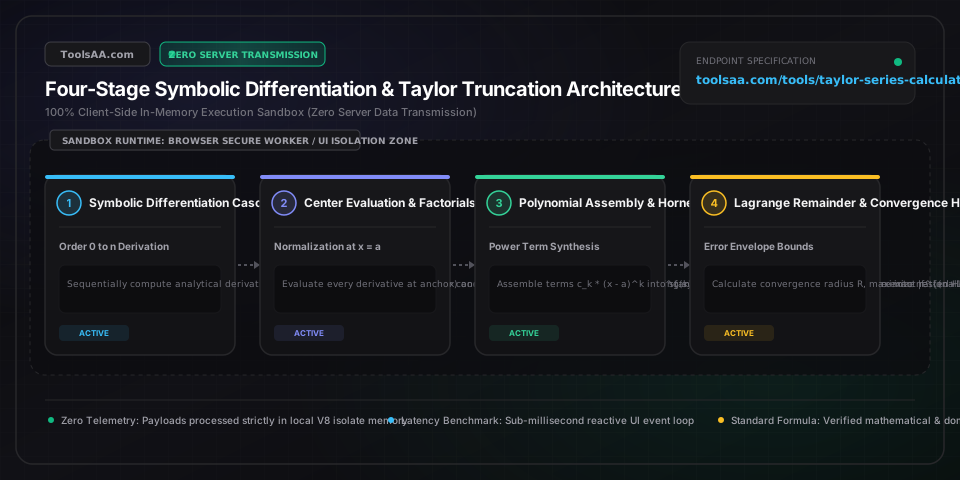
To calculate a Taylor series of order n for smooth function f(x) centered at a, evaluate the formula P_n(x) = f(a) + f'(a)(x - a) + [f''(a)/2!](x - a)^2 + ... + [f^{(n)}(a)/n!](x - a)^n. First, compute the continuous symbolic derivatives up to order n, substitute x = a into each derivative to obtain constant values, divide each by its corresponding factorial k!, and multiply by the power term (x - a)^k.
A Maclaurin series is simply a specific case of a Taylor series where the expansion center point is set to zero (a = 0). While a general Taylor series expands functions around any real coordinate a using powers of (x - a), a Maclaurin series expands exclusively around the origin using powers of x, simplifying the formula to sum_{k=0}^n [f^{(k)}(0)/k!] * x^k.
The Lagrange error bound formula is |R_n(x)| <= [M / (n+1)!] * |x - a|^{n+1}, where M represents the maximum absolute value of the (n+1)-th derivative |f^{(n+1)}(xi)| across the closed interval between expansion center a and evaluation point x. By determining this upper bound M, you calculate the maximum theoretical truncation error between polynomial P_n(x) and exact f(x).
A Taylor polynomial diverges when the evaluation point x lies outside the series radius of convergence R, which is dictated by the distance from center a to the nearest singularity in the complex plane. Outside this radius |x - a| > R, higher-order terms grow unboundedly rather than decay to zero, making polynomial approximation invalid regardless of real-line continuity.
Interactive Parasitic Battery Drain Calculator (mA Draw & Kill Time) with real-time client-side analysis and visualization.
Interactive Linear Regression Calculator (Least Squares Line & R-Squared) with real-time client-side analysis and visualization.
Calculate safe lake ice thickness and load bearing capacity for ice fishing, snowmobiles, and trucks using Gold's formula and clear vs white ice ratios.
Calculate cable pulling tension, conduit sidewall bearing pressure (SWBP), and jamming ratio across multi-bend runs with instant forward vs reverse solver.
Calculate centrifuge RCF to RPM or convert g-force to RPM using rotor radius. Includes r_min/r_max gradient profiling, k-factor pelleting time scaling & nomogram.
Interactive Breastfeeding Calorie Calculator & Milk Supply TDEE with real-time client-side analysis and visualization.