/
Equipment Lease vs Buy & NPV Calculator
Badge enterprise engineBadge asc842 compliantBadge arbitrary precision

Equipment Lease vs Buy & NPV Calculator

Enterprise-grade equipment lease vs buy financial evaluation engine. Computes after-tax Net Present Cost (NPC), Section 179 expensing, MACRS and international capital allowances, debt amortization schedules, terminal salvage recapture, and dual break-even solvers with dynamic sensitivity matrices.

Lbl quick scenarios
Kpi verdict titleBadge buy cheaper
$19,111

Kpi buy advantage desc

Lbl advantage percent:10.6%
Kpi npc buy titleLbl debt tax shield
$180,325

Lbl down payment label: $56,000 (20%)

Lbl monthly debt pmt:$4,489/Unit mo
Kpi npc lease titleLbl op ex deductions
$199,436

Lbl monthly lease pmt: $4,850/Unit mo

Lbl lease upfront after tax:$7,178
Kpi indifference titleBadge indifference formula
Lbl break even salvage:$37,053
Lbl break even lease rate:$4,311/Unit mo
Lbl current salvage assumed:$75,000

Title control cockpit

US Lbl regime suffix
$280,000
$
20% ($56,000)
$6,500/Unit yr

Chart cumulative npc title

Chart cumulative npc sub

Lbl legend buyLbl legend lease
$56K$62K$104K$145K$184K$180K$7.2K$52K$93K$131K$166K$199KLbl yr prefix 0Lbl yr prefix 1Lbl yr prefix 2Lbl yr prefix 3Lbl yr prefix 4Lbl yr prefix 5
Chart takeaway titleChart takeaway buy

Title regulatory disclosures

Disc asc842 title

Disc asc842 body

Disc sec179 title

Disc sec179 body

Disc obsolescence title

Disc obsolescence body

Stat calcs doneStat arbitrary precision
Stat npc advantage$19,111
Stat terminal basis$24,987
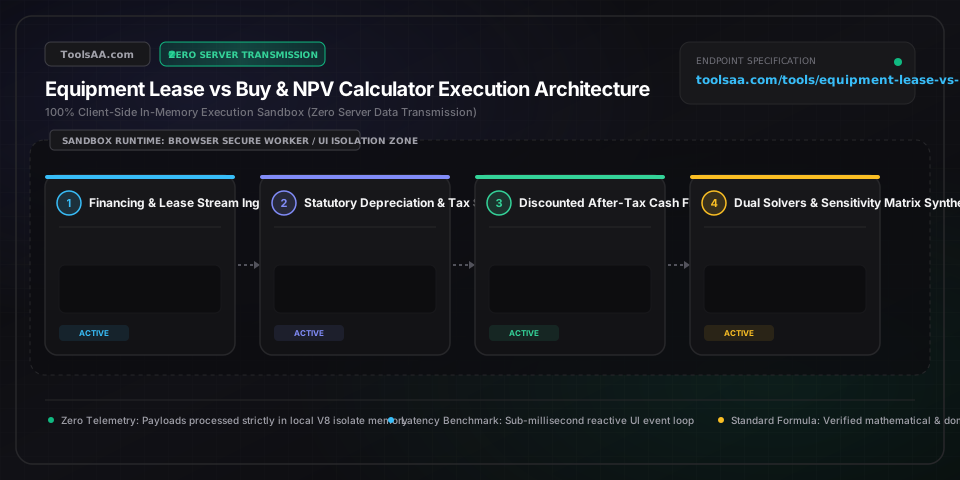
Technical Reference & Architecture Guide

Equipment Lease vs Buy & NPV Calculator Guide

Enterprise-grade equipment lease vs buy financial evaluation engine. Computes after-tax Net Present Cost (NPC), Section 179 expensing, MACRS and international capital allowances, debt amortization schedules, terminal salvage recapture, and dual break-even solvers with dynamic sensitivity matrices.

Equipment Lease vs Buy & NPV Calculator Guide — Client-Side In-Memory Architecture & Data Flow

Key Parameters & Controls

Delivered Equipment Purchase Price & Capital OutlayCapital Expenditure ($ / £ / € / ¥)

Total all-in delivered asset cost including freight, rigging, site modification, and initial calibration before statutory sales tax adjustments. Statutory threshold benchmark: Under IRC §179, full expensing phases out dollar-for-dollar between $3,050,000 and $4,270,000 (2024 limits), establishing the strict capital boundary for immediate write-offs.

Default: $100,000
After-Tax Net Present Cost (NPC)Discounted Cash Flow Metric ($ / £ / € / ¥)

Cumulative discounted present value of debt service, down payments, lease rentals, and maintenance cash outflows, offset by interest tax shields and depreciation tax shields minus terminal salvage recapture: NPC = Outlay_0 + Σ(CF_t / (1 + WACC)^t) - Salvage_N / (1 + WACC)^N. Lower NPC denotes capital conservation; a delta of 3% to 5% often dictates procurement authorization.

Default: Comparative Delta
Weighted Average Cost of Capital (WACC) Discount RateHurdle Rate / Opportunity Cost (%)

The enterprise marginal hurdle rate combining after-tax cost of debt Rd*(1 - Tc) and cost of equity Re weighted by capital structure. Institutional benchmark ranges from 6.5% for investment-grade industrials to 12.0%-15.0% for leveraged middle-market firms; higher rates discount distant lease outlays more aggressively, favoring lease structures.

Default: 8.50%
Break-Even Terminal Salvage Value (S_be)Asset Liquidation Boundary ($ / £ / € / ¥)

The net asset resale valuation at horizon year N where NPC(Buy) strictly equals NPC(Lease): S_be = [NPC_buy(S=0) - NPC_lease] / [(1 - Tc) * (1 + WACC)^(-N)]. Resale valuations exceeding S_be establish mathematical dominance for debt-financed ownership over operating lease contracts.

Default: $18,450
IRC Section 179 & Bonus Depreciation Tax ShieldStatutory First-Year Deduction ($)

Immediate first-year asset expensing allowance capped at $1,220,000 with 60% bonus depreciation under TCJA phase-down. Generates an immediate Year 1 cash tax shield equal to Expensing * Marginal Tax Rate, converting up to 21% (federal) + 5-10% (state) of asset purchase price into liquidity within Month 12.

Default: $100,000

Pro Tips & Best Practices

Tax Asymmetry Arbitrage via Lessor Shield Monopolization

If your corporate entity is operating within an NOL (Net Operating Loss) carryforward window or an effective sub-15% tax bracket, you forfeit the economic value of front-loaded Section 179 and MACRS depreciation. Institutional lessors in the top 21% federal plus state brackets can monetize 100% of the MACRS tax shield, allowing you to negotiate lower implicit lease interest rates (money factors) that arbitrage their tax advantage into your reduced monthly payments.

Mid-Quarter MACRS Depreciation Cliff Trap

Under IRS Publication 946, if more than 40% of your aggregate depreciable tangible property is placed in service during Q4 (months 10-12), the standard Half-Year Convention is automatically revoked and replaced with the Mid-Quarter Convention. This retroactively shrinks your Q1 equipment depreciation allowance from 20.0% down to 8.75% for 5-year MACRS property, destroying anticipated first-year tax shield cash flows.

Residual Value FMV Tech Return Penalties

Fair Market Value (FMV) tech leases shift obsolescence risk to the lessor, but standard master lease agreements embed punitive 'return in like-new operating condition' clauses, mandatory OEM recertification audits, and de-installation penalties. In environments with harsh thermal or physical cycling, end-of-lease refurbishment surcharges can erode up to 12% to 18% of original equipment cost, eliminating initial lease savings.

Inflationary Fixed-Rate Debt Devaluation Hedge

Securing commercial term debt at a fixed nominal APR in an inflationary climate allows you to repay principal with depreciated currency while preserving 100% of the asset's secondary market liquidation equity. Conversely, operating leases with CPI-indexed renewal riders pass inflationary replacement costs directly back to the lessee.

Common Gotchas & Troubleshooting

⚠️Break-Even Salvage Value Displays as a Negative Number

A negative break-even salvage value (S_be < $0) indicates the debt purchase structure is so economically superior—due to aggressive upfront Section 179 deductions, low commercial loan APR, or excessive lessor margins—that buying remains financially optimal even if you paid a cash disposal fee to scrap the machine at Year N.

⚠️Section 179 Deduction Clamped Below Equipment Invoice Value

The model automatically caps the first-year deduction when equipment cost exceeds the statutory IRS IRC §179 annual ceiling ($1,220,000) or enters the dollar-for-dollar phase-out zone beginning at $3,050,000. Verify whether remaining basis qualifies for 60% Bonus Depreciation before routing the unexpensed balance through standard 5-year or 7-year MACRS recovery tables.

⚠️Financing Amortization Term Shorter Than Evaluation Horizon

When commercial loan tenor (e.g., 36 months) is shorter than asset useful life (e.g., 60 months), debt service cash outflows drop to zero in Years 4 and 5 while maintenance expenses and operational revenues persist. Align the cash flow horizon to the full economic useful life to prevent understating the terminal residual value of ownership.

⚠️Nominal Undiscounted Outlay Contradicts Net Present Cost Verdict

Purchasing frequently requires higher cumulative undiscounted cash outlays than leasing due to nominal financing interest and initial equity down payments. However, Net Present Cost heavily discounts future debt payments while valuing immediate Year 1 tax deductions at 100 cents on the dollar, proving why discounted cash flow analysis overrides nominal accounting totals.

Frequently Asked Questions

How do you calculate equipment lease vs buy NPV?▼

To calculate equipment lease vs buy Net Present Value (NPV) or Net Present Cost (NPC), discount all projected after-tax cash flows over the asset's economic life using your Weighted Average Cost of Capital (WACC). For purchasing, compute: Initial Down Payment + Present Value of After-Tax Debt Service (Principal + Interest*(1 - Tax Rate)) + PV of After-Tax Maintenance - PV of Depreciation Tax Shields (Depreciation * Tax Rate) - PV of After-Tax Resale Salvage. For leasing, compute: Upfront Inception Fees + PV of After-Tax Lease Payments (Rent*(1 - Tax Rate)) + PV of After-Tax Operating Expenses. The procurement option generating the lower Net Present Cost minimizes enterprise capital consumption.

When is it financially better to lease equipment instead of buying?▼

Leasing is mathematically superior under four specific financial conditions: (1) Rapid technological obsolescence cycles (36 to 48 months for IT infrastructure, telecommunications, or robotic diagnostic systems) where residual disposal risk is transferred to the lessor; (2) The acquiring firm has zero or negative taxable income (NOL carryforwards), rendering accelerated Section 179 and MACRS tax shields useless; (3) The enterprise faces restrictive senior debt covenants or liquidity constraints with capital costs exceeding 12-15%; or (4) The contract is a true Full-Service Gross lease where the lessor provides preventive maintenance and insurance below internal operational cost.

How does Section 179 and MACRS depreciation impact the lease vs buy decision?▼

Depreciation acts as a cash tax shield that lowers the effective purchase price. Under IRS Section 179, qualifying businesses can immediately deduct up to $1,220,000 of equipment purchases in Year 1, rather than capitalizing and amortizing over 5 to 7 years. For an enterprise subject to a combined 25% corporate income tax rate, expensing a $300,000 machine yields an immediate $75,000 cash tax savings in Year 1. Because of the time value of money, receiving cash tax shields in Year 1 rather than spread across Year 6 or 7 dramatically reduces the Net Present Cost of purchasing, heavily tilting the economic balance toward debt ownership.

What is break-even salvage value in an equipment lease vs buy analysis?▼

The break-even salvage value is the exact net resale price required at the end of the analysis period for the Net Present Cost of buying to equal the Net Present Cost of leasing: S_be = [NPC_buy(Salvage=0) - NPC_lease] / [(1 - Marginal Tax Rate) * (1 + WACC)^(-N)]. If secondary liquid market data (such as Ritchie Bros. or EDA auction indices) indicates the asset will hold a market value above S_be, purchasing is the optimal capital decision. If projected resale is lower than S_be, leasing insulates the business from residual market degradation.

How do ASC 842 and IFRS 16 lease standards impact the lease vs buy decision?▼

Under US GAAP (ASC 842) and IFRS 16, operating leases can no longer be hidden as off-balance-sheet financing; lessees must capitalize all leases exceeding 12 months as a Right-of-Use (ROU) asset alongside a corresponding lease liability. While this increases reported balance sheet debt ratios and alters EBITDA (operating lease expense is reclassified as amortization and interest under IFRS 16), it does not alter underlying cash taxes or discounted cash flows. The fundamental financial decision remains governed by after-tax Net Present Cost rather than cosmetic balance sheet presentation.

How does discount rate or WACC affect whether you should lease or buy?▼

Disclaimer: This tool is provided strictly for educational and informational purposes only and does not constitute formal financial advice or a binding loan commitment. Please consult a qualified financial advisor before making decisions. The discount rate represents the opportunity cost of deploying capital into core operational projects versus financing equipment. High discount rates (10% to 16%) heavily penalize immediate capital expenditures (down payments and early debt service) while heavily discounting lease payments that occur in Years 3 through 5, making leasing mathematically attractive. Low discount rates (3% to 6%) preserve the present value of future equipment ownership and salvage recovery, reinforcing the economic dominance of purchasing.

Related Tools & Utilities

All Tools →