/
Sausage Meat Fat Ratio & Cure Calculator

Sausage Meat Fat Ratio & Cure Calculator

Professional charcuterie and sausage formulation calculator. Solves reverse pork back fat additions for wild game or trimmed cuts, calculates USDA-compliant Cure #1 sodium nitrite ppm, standardizes Baker's percentage seasonings, and computes casing yardage and finished cured yields.

Lbl quick presets

Section meat balance

Unit lbs

Hint lean base

Lbl venison elkLbl pork loinLbl pork butt
Lbl target fat percentage25% Kpi fat label / 75% Kpi lean
Fat profile leanFat profile bratFat profile traditionalFat profile salami

Section seasoning cure

Lbl basis green meat
Lbl salt rate2.00% (0.196 Unit lbs)
Salt lowSalt idealSalt high
Cure ppm output 156.3 ppm (Cure ppm std)
Hint ice
Lbl dextrose0.50% (0.049 Unit lbs)

Section casings and thermal

Title batch scaler1x
Kpi total batch9.81 Unit lbs157 Unit oz
Kpi fat ratio25.0%75.0% Kpi lean
Kpi fat trim needed2.31 Unit lbs36.9 Unit oz
Kpi finished yield8.83 Unit lbs-18.0% Kpi moisture

Title visual cockpit

Chart ratio label75 / 259.81 Unit lbs
Legend lean: 75.0%
Legend fat: 25.0%
Gauge nitrite title
156.3 PPMGauge elevated
Sensory optimum title75/25

Sensory optimum desc

Title prep sheet

Col ingredientCol baker pctCol weight primary (Unit lbs)Col weight secondary (Unit oz)Col function
Ing lean meat76.5%7.50120.0Act grind coarse
Firm Pork Back Fat (90% Fat / 10% Moisture)23.5%2.3136.9Act semi freeze
Ing salt2.00%0.1963.1Act salt
Cure1 name0.25%0.0250.4156 Ppm protection
Ing ice water5.0%0.4907.8Act ice
Ing binder row2.0%0.1963.1Act binder
Ing dextrose row0.50%0.0490.8Act sugar
Total stuffed green109.8%10.76172.2Ready to stuff

Title casing yield

Casing need title
4.3 Unit feet (1.3 Unit meters)
Calibrated for Natural Beef Middle 55-60mm (Summer Sausage / Bologna) (~7 Unit links)
Butcher tip casing
Yield title
8.83 Unit lbs (141.2 Unit oz)
Shrinkage rate: 18.0% (1.94 Unit lbs Moisture purge)
Internal cook temp

Title master guide

Step1 num

Step1 desc

Step2 num

Step2 desc

Step3 num

Step3 desc

Step4 num

Step4 desc

Step5 num

Step5 desc

Disclaimer title

Disclaimer text

Client-Side Processing

High-performance calculation executed entirely in browser memory.

Zero Server Upload Privacy

All payloads remain strictly local with zero external server communication.

Production Ready Export

Clean, optimized output formats ready for immediate deployment.
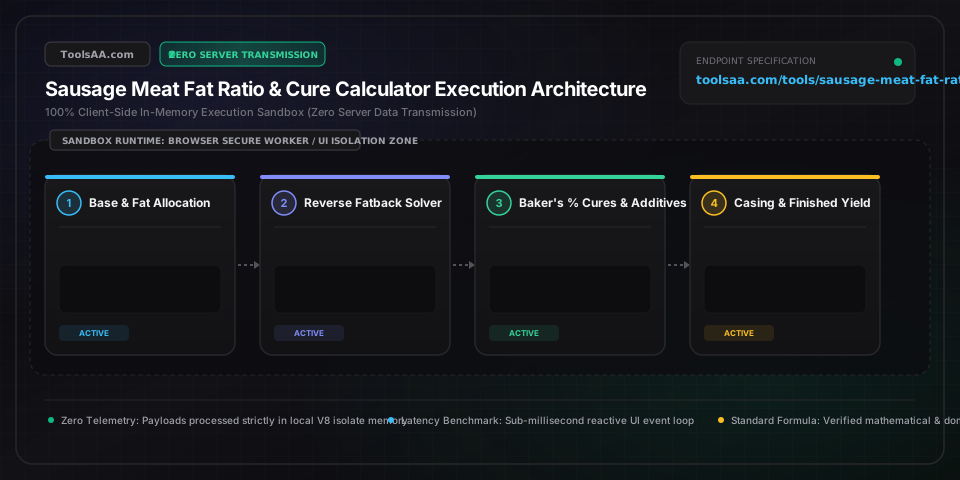
Technical Reference & Architecture Guide

Sausage Meat Fat Ratio & Cure Calculator Guide

Professional charcuterie and sausage formulation calculator. Solves reverse pork back fat additions for wild game or trimmed cuts, calculates USDA-compliant Cure #1 sodium nitrite ppm, standardizes Baker's percentage seasonings, and computes casing yardage and finished cured yields.

Sausage Meat Fat Ratio & Cure Calculator Guide — Client-Side In-Memory Architecture & Data Flow

Key Parameters & Controls

Target Lean-to-Fat Ratio (Lipid Matrix Proportion)Percentage Ratio (% Lean / % Fat)

The target proportion of structural lipid fat to lean skeletal muscle required to coat muscle fibrils, prevent dry chewiness, and carry fat-soluble aromatics. Fresh sausages achieve peak juiciness between 75/25 and 70/30; falling below 80/20 results in a rubbery, crumbly crumb, while exceeding 65/35 causes greasy pooling.

Default: 75/25 (Fresh Links) or 70/30 (Emulsified)
Baseline Salt Concentration (Myosin Extraction Agent)Baker's Percentage (% of Green Meat Block)

Essential ionic solute calculated against total trimmed green meat weight. At the 1.8% to 2.2% threshold, sodium chloride dissolves and denatures intracellular myofibrillar proteins (myosin and actin), forming a sticky exudate matrix that entraps moisture and liquefied fats during thermal processing.

Default: 1.8% to 2.0% (Fresh) | 2.5% to 3.0% (Dry-Cured)
Prague Powder #1 (Cure #1 / 6.25% Sodium Nitrite)Mass Percentage / Concentration (ppm)

Curing salt formulated with 93.75% sodium chloride and 6.25% sodium nitrite, tinted pink for safety. Dosing at strictly 0.25% of total meat mass injects exactly 156.25 ppm active sodium nitrite, satisfying USDA FSIS statutory mandates to inhibit neurotoxin synthesis by Clostridium botulinum in low-temperature smoking chambers below 140°F (60°C).

Default: 0.25% (2.5 g/kg or 1 level tsp per 5 lbs)
Crushed Ice Hydration Fluid (Friction Thermal Buffer)Baker's Percentage (% of Total Meat Mass)

Cold liquid mass blended during paddle agitation to solubilize the salt-protein suspension and buffer mechanical blade friction. Keeps batter temperatures strictly below the critical 50°F (10°C) threshold where pork lipids melt and smear, preventing emulsion collapse during cooking.

Default: 3.0% to 8.0% (Crushed Ice Slurry)
Trimmed Base Meat Lean Percentage (Pre-Blend Game/Primal)Percentage (% Native Lean Content)

Native lean muscle density of the base protein block prior to fatback adjustment. Wild venison or elk trimmings register 95% to 97% pure lean with zero usable tallow, requiring reverse Pearson Square fat balancing using firm 90% lipid pork backfat.

Default: 95% (Wild Venison/Elk) or 80% (Pork Shoulder)

Pro Tips & Best Practices

Enforce the Strict 50°F (10°C) Temperature Threshold

Always chill meat cuts, grinder plates, knife, auger, and stuffer horn to near freezing (28°F to 32°F / -2°C to 0°C) for at least 60 minutes prior to processing. If the farce warms past 50°F (10°C), cellular lipid walls rupture and smear across blade edges, coating muscle fibers with oil and permanently destroying the protein emulsion, which leads to massive fat-out in the smoker.

Execute the Sticky Palm Farce Test Before Stuffing

Vigorously mix ground meat, salt, and crushed ice slurry until myofibrillar protein myosin is fully extracted into tacky white fibrils. Test emulsion readiness by scooping a 2-ounce meatball onto your flat, open palm and turning your hand upside down; if the meat adheres securely for 5 full seconds without peeling away, the protein-fat binding matrix is fully developed.

Discard 100% of Wild Game Tallow and Substitute Cold Pork Back Fat

Venison, elk, and pronghorn deer fat is loaded with high-melting-point stearic acid and volatile branched-chain fatty acids that solidify into a waxy palate coating and turn oxidatively rancid within weeks. Carve away every trace of wild tallow down to pure red muscle, and substitute chilled, firm pork back fat (90% pure fat) at 25% to 30% of your total batch weight.

Lukewarm Vinegar Flush for Natural Hog and Sheep Casings

Soak salted natural casings in warm tap water (85°F / 30°C) with 1 tablespoon of distilled white vinegar for 45 minutes to dissolve salt crusts and soften collagen fibrils. Slide one end over the kitchen faucet to run lukewarm water entirely through the lumen; this flushes interior salt granules, eliminates gamey packing odors, and lubricates the stuffing horn to prevent friction blowouts.

Immediate 10-Minute Ice-Shock Bath After Smoking

Never allow hot smoked links to cool at room ambient temperatures. The moment links hit an internal core temperature of 152°F (67°C), immediately submerge them in an ice-water slurry for 10 minutes. This thermal snap halts carryover cooking, contracts natural casing proteins tightly against the farce, and eliminates wrinkling or shriveling.

Common Gotchas & Troubleshooting

⚠️Fat-Out and Greasy Pockets Forming Under the Casing During Smoking or Grilling

This failure occurs when the meat batter exceeds 50°F (10°C) during mechanical grinding or mixing, or salt drops below 1.5%, preventing myosin protein extraction. To safeguard subsequent batches, freeze grinder plates and cubed meat to 30°F (-1°C) before grinding, ensure base salt is calculated at 1.8% to 2.0%, mix until tacky, and blend in 1.5% to 2.0% non-fat dry milk powder (NFDM) or soy protein concentrate to chemically bind escaping lipids.

⚠️Crumbly, Mealy, and Dry Texture Reminiscent of Loose Ground Beef

Caused by three primary errors: fat percentage under 18%, insufficient mechanical mixing without hydration fluid, or overcooking past 165°F (74°C), which contracts muscle fibers and wrings out moisture. Recalibrate your fat ratio to at least 75/25, add 5% to 8% crushed ice slurry during paddle mixing until tacky spiderweb threads develop, and use a probe thermometer to stop cooking when internal pork temperature reaches exactly 152°F (67°C).

⚠️Wrinkled, Shrivelled, and Loose Casings After Cooling

Under-stuffing into the casing or air pockets left during extrusion causes steam contraction to pull the casing away from the meat core during slow room-temperature cooling. Maintain steady counter-pressure on the horn with your thumb and forefinger to stuff casings taut (without rupturing), prick trapped air bubbles with a sausage pricker, and plunge hot links directly into an ice-water bath for 10 minutes immediately upon pulling from the smoker.

⚠️Burst Casings During Link Twisting or Hot Pan Searing

Caused by over-packing during stuffing or twisting all links in the same alternating direction. Stuff casings to approximately 85% to 90% volume capacity to allow physical displacement during linking. Always pinch the link interval firmly, then spin link #1 clockwise 3 full rotations, skip link #2, and spin link #3 counter-clockwise 3 rotations to avoid untwisting or tearing adjoining walls.

Frequently Asked Questions

How do you calculate how much pork fat to add to lean venison or game meat?▼

Use the reverse Pearson Square fat addition formula: Required Fat Weight = Base Meat Weight × [(Target Fat % - Native Lean Meat Fat %) / (Fat Source Fat % - Target Fat %)]. For example, to convert 10 lbs of trimmed deer venison (3% native fat) into a 75/25 sausage formulation using firm pork back fat (90% pure fat): 10 × [(0.25 - 0.03) / (0.90 - 0.25)] = 10 × [0.22 / 0.65] = 3.38 lbs of pork back fat. This yields a total green batch weight of 13.38 lbs at an exact 25% fat ratio. Never use wild deer tallow, as its high stearic acid content creates a waxy, unpleasant mouth coating.

How much salt and Cure #1 should be added per pound or kilogram of sausage?▼

Add 1.8% to 2.0% non-iodized salt (18 to 20 grams per kilogram, or approx. 0.3 oz per pound) and exactly 0.25% Prague Powder #1 (2.5 grams per kilogram, or 1 level teaspoon per 5 lbs of total meat block). The 1.8% salt threshold is required to chemically dissolve myosin muscle proteins for a firm emulsion. Prague Powder #1 (6.25% sodium nitrite) provides exactly 156.25 parts per million (ppm) of active nitrite, matching USDA Food Safety and Inspection Service (FSIS) requirements to inhibit Clostridium botulinum spore germination during low-temperature smoking below 140°F (60°C).

What is the difference between Prague Powder #1 and Prague Powder #2?▼

Prague Powder #1 (InstaCure #1) contains 6.25% sodium nitrite and 93.75% table salt, engineered for short-term curing and smoking cooked or hot-smoked sausages (such as Kielbasa, hot dogs, and snack sticks) that cook within hours or days. Prague Powder #2 (InstaCure #2) contains 6.25% sodium nitrite plus 4.0% sodium nitrate and 89.75% table salt, formulated strictly for dry-cured, uncooked charcuterie aged over weeks or months (such as Genoa salami, pepperoni, and soppressata). The sodium nitrate in Cure #2 acts as a slow-release time capsule, breaking down into nitrite over long aging periods to provide continuous antimicrobial protection against botulism.

What is the ideal meat to fat ratio for homemade sausage?▼

The culinary benchmark for fresh and smoked links is 75/25 (75% lean muscle to 25% fat), with emulsified sausages like Bavarian Bratwurst thriving at 70/30. Sausages leaner than 80/20 turn chalky, crumbly, and dry because lean muscle fibrils contract during cooking and wring out cellular water without melted lipids to replace it. A 25% to 30% firm pork backfat ratio coats muscle fibers, traps savory moisture, stabilizes spices, and delivers the characteristic tender 'snap' when bitten.

Why is ice water added to sausage meat during mixing?▼

Ice water (dosed at 3% to 8% of meat block weight) fulfills two critical food-science roles: thermal regulation and myofibrillar protein activation. High-speed paddle agitation generates friction heat that can easily push meat above 50°F (10°C), causing pork fat to soften, coat muscle fibers, and ruin the bind. Introducing crushed ice slurry absorbs this kinetic heat while providing the liquid volume required to dissolve salt crystals and draw out myosin into a tacky, sticky protein matrix that permanently locks in juices.

How much natural hog casing do I need per pound of sausage meat?▼

Standard 32-35mm natural hog casing accommodates approximately 0.45 to 0.50 lbs of meat batter per linear foot (approx. 2.0 to 2.2 feet per pound, or 1.4 meters per kilogram). A commercial 100-yard hank (300 feet or 91.4 meters) stuffs approximately 110 to 125 lbs (50 to 56 kg) of sausage. For smaller batches, prep 11 feet of hog casing for 5 lbs of meat, or 22 feet for a 10-lb batch, always factoring in a 10% safety buffer for knotting and linking ends.

Related Tools & Utilities

All Tools →