Wallpaper Calculator & Roll Estimator

Wallpaper Calculator & Roll Estimator

Badge pdca

Calculate wallpaper rolls, square footage, and waste with pattern repeat matching, window deductions, and roll size presets for standard or custom rooms.

Title room config
Unit ft
Unit ft
Lbl trim allowance:
Title deductions
×
×
Title roll specDesc roll spec
Unit in
Unit ft
Title pattern match
Unit in
Title domain vars
10Unit percent
Lbl total strips: 9Lbl gross coverage: 225.5 Unit sq ft
Badge pdca
Lbl recommended rolls
4Unit rolls
Lbl dye lot included
56%
Lbl usability yield
Lbl total cost$253.00Lbl exact rolls needed: 3
Lbl net wall area126.0Unit sq ft
Lbl gross coverage225.5Unit sq ft
Lbl waste percentage44.1%99.5 Unit sq ft
Lbl drops per roll3Lbl remnant scrap: 1.5 Unit ft
Title bolt breakdown33 Unit ft Lbl total bolt
Lbl drop #1
Lbl drop #2
Lbl drop #3
Lbl scrap
Lbl pitched length:10.5 Unit ft (Lbl raw height trim: 9.3)
Lbl adhesive required:3 Unit quarts (Opt non woven)
Lbl primer required:0.4 Unit gallons
Lbl deducted area:0.0 Unit sq ft (Opt pdca threshold)

Title dye lot alert

Desc dye lot alert

Lbl effective roll yield: 56.4 Unit sq ft100% Client-Side Privacy
Lbl recommended rolls
4Unit rolls
Lbl gross coverage: 225.5 Unit sq ft
Lbl waste percentage
44.1%(9 Unit strips)
Lbl pitched length: 10.5 Unit ft
Lbl total cost
$253.00
Lbl rolls cost: $192.00 + Lbl paste cost: $36.00

Client-Side Processing

High-performance calculation executed entirely in browser memory.

Zero Server Upload Privacy

All payloads remain strictly local with zero external server communication.

Production Ready Export

Clean, optimized output formats ready for immediate deployment.
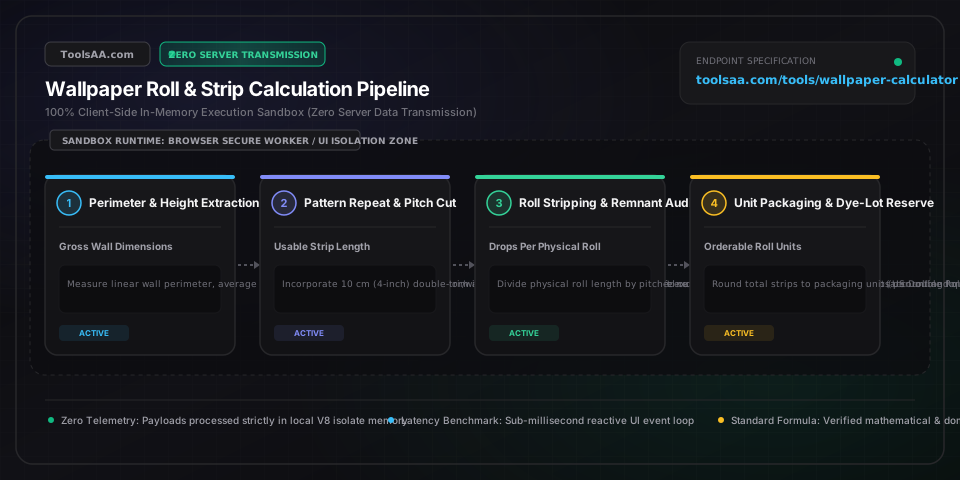
Technical Reference & Architecture Guide

Wallpaper Calculator & Roll Estimator Guide

Calculate wallpaper rolls, square footage, and waste with pattern repeat matching, window deductions, and roll size presets for standard or custom rooms.

Wallpaper Calculator & Roll Estimator Guide — Client-Side In-Memory Architecture & Data Flow

Key Parameters & Controls

Linear Wall Perimeter & WidthDistance (Feet / Meters)

Total horizontal distance of all surfaces to be papered. Under Painting and Decorating Contractors of America (PDCA) standards, measurements must be taken along baseboards with ceiling height verified at minimum 3 equidistant points (corners and center) to capture floor deflection and ceiling slope.

Default: 48 ft (14.6 m)
Ceiling Height with Trimming MarginDistance (Feet / Meters)

Finished vertical wall height from baseboard to cornice or ceiling line. Professional paperhangers enforce a non-negotiable 10 cm (4-inch) double-trim allowance (5 cm / 2 in top and bottom) to ensure straight horizontal razor trimming along uneven plaster boundaries.

Default: 8.0 ft (2.44 m)
Vertical Pattern Repeat IntervalDistance (Inches / Centimeters)

The vertical interval between identical design elements (commonly 0 cm for plain/textured, 13 cm to 64 cm for florals and geometric prints). In straight and drop matches, the usable strip cut length must be rounded up to the nearest integer multiple of this repeat interval: ceil((Height + Trim) / Repeat) * Repeat.

Default: 21.0 in (53.3 cm)
Pattern Match Type AlignmentMatch Category (Random / Straight / Drop)

Defines how motifs align horizontally across adjacent wallpaper strips. Straight match aligns identical points at identical heights (10-15% scrap). Half-drop match shifts alternating strips vertically by 50% of the repeat (15-25% scrap). Random match requires zero vertical alignment.

Default: Straight Match
Roll Packaging Specification UnitRoll Dimension (Width x Length)

Physical roll dimensions based on manufacturing origin: US Double Roll / Bolt (20.5 in x 33 ft / 56.4 sq ft or 27 in x 27 ft / 60.8 sq ft), Euro Standard Roll (53 cm x 10.05 m / 5.33 m2), or Commercial 54-inch contract vinyl (1.37 m x 27.4 m / 30-yard bolt).

Default: US Double Roll (20.5 in x 33 ft)
Dye-Lot Reserve Safety MarginContingency Buffer (Percentage & Spare Roll)

Percentage buffer (10% to 20%) applied to account for pattern positioning scrap, corner wrapping cuts, and obstacle trimming. Recommends purchasing +1 reserve bolt from the identical manufacturing run/dye lot to guard against irreversible shade banding in case of future water damage or seam repair.

Default: 10% + 1 Reserve Roll

Pro Tips & Best Practices

The US Double Roll Pricing Trap

North American wallpaper manufacturers and retailers almost universally quote prices per 'single roll' (approx. 28 sq ft) to make pricing appear cheaper, but package, ship, and invoice exclusively in 'double rolls' (bolts of ~56 sq ft). If your calculation calls for 8 single rolls, you must order 4 double rolls. Confirm whether your checkout cart reflects single rolls or physical bolts before paying.

The 15-Square-Foot Deduction Fallacy

Unlike painting where every square foot of an opening saves paint, wallpaper strips must span across openings continuously. According to PDCA guidelines, never deduct doors or windows smaller than 15 sq ft (1.4 m2) or narrower than a single roll width. A 20.5-inch strip sliced by an 18-inch bathroom window still consumes the entire vertical drop, generating unusable scrap rather than savings.

Half-Drop Two-Roll Alternating Cut Protocol

On half-drop patterns, cutting consecutive strips from a single roll produces extreme waste because strip #2 requires a 50% repeat drop offset from strip #1. Professional installers open two rolls simultaneously: cut odd-numbered strips (#1, #3, #5) from Roll A, and even-numbered strips (#2, #4, #6) from Roll B. This technique recaptures up to 20% of otherwise wasted offcuts.

Inside Corner Slit and Plumb Line Reset

Never wrap a full width of wallpaper around an inside corner. No architectural corner is perfectly vertical; wrapping past a corner causes the paper to twist, bubble, and tilt the vertical pattern out of plumb across the entire next wall. Always slit the paper vertically into the corner, wrap a 1/8-inch (3 mm) return onto the adjacent wall, and strike a fresh plumb line with a laser or level for the next strip.

Common Gotchas & Troubleshooting

⚠️Pattern motifs creeping out of horizontal alignment across adjacent wall drops

Pattern drift occurs when paper-backed wallpaper is hung without adequate booking relaxation time (causing paper to expand unevenly on the wall) or when the initial plumb line was off by even 1 mm. Check manufacturer booking specifications (typically 3 to 5 minutes for pre-pasted or paste-the-paper; zero booking for paste-the-wall non-wovens). Always align the pattern at primary eye level first, gently massaging tension outward toward the top and bottom trim margins.

⚠️Calculated roll estimate leaves an awkward 2-inch vertical sliver at the final wall corner

Occurs when starting the first strip flush against a corner without pre-calculating the wall's modular strip width. Divide the total wall width by your roll width: if the remainder is under 5 cm (2 inches), do not start with a full strip at the edge. Instead, offset the starting plumb line by half a roll width so that both opposing corners terminate with substantial, visually balanced partial strips.

⚠️Adhesive paste ran dry before paperhanging reached the final wall

Unsealed or porous drywall absorbs water rapidly from wallpaper adhesive, starving the seam and doubling paste consumption. Always prime drywall with an acrylic or PVA wallcovering sizing primer (such as Roman PRO-977 or Zinsser Shieldz) 24 hours prior. Properly sized walls stabilize adhesive open time and maintain the benchmark coverage rate of 1 gallon per 250-300 sq ft (or 1 kg per 5-6 m2).

⚠️Noticeable side-to-side shade banding between adjacent rolls under natural daylight

Shade banding results from mixing different manufacturing batch/dye lot numbers or failing to reverse-hang unpatterned wallcoverings. Inspect roll packaging labels to verify that the Run/Lot letters match identically. For solid textures, silks, and natural grasscloths, adhere to the Wallcoverings Association WA-101 specification: invert every second strip 180 degrees (top-to-bottom) during installation to balance natural side-to-side weave and sheen gradients.

Frequently Asked Questions

How do I calculate how many rolls of wallpaper I need?▼

To calculate wallpaper rolls accurately, determine total required strips: Strip Count = ceil(Total Wall Perimeter / Roll Width). Next, determine the usable strip cut length by adding a 10 cm (4-inch) trim allowance to ceiling height and rounding up to the nearest multiple of the pattern repeat: Cut Length = ceil((Ceiling Height + Trim) / Pattern Repeat) * Pattern Repeat. Then calculate Strips Per Roll = floor(Roll Length / Cut Length). Finally, Total Rolls = ceil(Strip Count / Strips Per Roll) multiplied by a 10% to 15% waste margin, rounding up to the nearest whole roll or double-roll bolt.

What is the difference between straight match and drop match wallpaper?▼

The difference lies in horizontal pattern alignment across adjacent wall drops: straight match wallpaper aligns identical pattern motifs horizontally at the exact same height on every strip, resulting in moderate waste (typically 10% to 15%). Drop match wallpaper (most commonly a half-drop) shifts the motif vertically on alternating strips by half the repeat distance, creating a diagonal flow. Drop match produces 15% to 25% scrap unless you cut odd and even strips from two alternating rolls simultaneously.

Should I subtract windows and doors when calculating wallpaper?▼

Only subtract large architectural openings exceeding 15 to 20 square feet (1.4 to 1.9 m2), such as multi-panel patio sliding doors, large archways, or French doors. Standard interior doors (approx. 21 sq ft) and regular windows (approx. 15 sq ft) should generally not be subtracted in residential rooms under 400 sq ft, because wallpaper is hung in continuous vertical rolls; offcuts above doors and below windows are frequently unusable due to pattern repeat alignment rules.

How much wallpaper do I need for a 10x10 room with 8-foot ceilings?▼

A 10x10 ft room has a 40 ft perimeter and 320 sq ft of gross wall surface. Using standard US Double Rolls (20.5 in wide x 33 ft long) and an 8 ft ceiling: 40 ft equals 480 inches, requiring 24 vertical strips (480 / 20.5 = 23.4, rounded up). For plain or random match wallpaper with 4-inch trim allowance (8.33 ft cut), each 33 ft roll yields 3 full strips (33 / 8.33 = 3.9), requiring exactly 8 double rolls (24 / 3 = 8). For a pattern with a 20-inch repeat, cut length increases to 10 ft (6 repeats), still yielding 3 strips per roll (33 / 10 = 3.3), requiring 8 double rolls plus 1 extra safety roll (9 double rolls total).

Related Tools & Utilities

All Tools →