Title bay visualizer
ZFS RAIDZ2 (Dual Parity vdev) • 4 Lbl bay Lbl status online
Lbl status online • 7,200 RPM Enterprise HDD (~200 MB/s) • URE: 10⁻¹⁵ (1 sector per ~125 TB) - NAS Pro / CMR
Calculate usable storage capacity in decimal TB and binary TiB across RAID 0, 1, 5, 6, 10, 50, 60, and ZFS RAIDZ1/Z2/Z3 arrays with parity overhead, URE rebuild crash risk, rebuild duration, and drive bay visualizer.
ZFS RAIDZ2 (Dual Parity vdev) • 4 Lbl bay Lbl status online
Lbl status online • 7,200 RPM Enterprise HDD (~200 MB/s) • URE: 10⁻¹⁵ (1 sector per ~125 TB) - NAS Pro / CMR
Calculate usable storage capacity in decimal TB and binary TiB across RAID 0, 1, 5, 6, 10, 50, 60, and ZFS RAIDZ1/Z2/Z3 arrays with parity overhead, URE rebuild crash risk, rebuild duration, and drive bay visualizer.
Governs the mathematical radix divergence between storage manufacturer decimal labeling (1 TB = 10^12 bytes) and binary addressing in POSIX systems (1 TiB = 2^40 = 1,099,511,627,776 bytes) compliant with IEC 80000-13 and IEEE 754-2019 precision standards. Executed locally via client-side JavaScript with O(1) complexity, this factor establishes an immutable 9.0949% apparent capacity reduction prior to filesystem structures or GPT EFI partitioning.
The statistical probability of encountering an unreadable physical sector during sequential array rebuilds, modeled as P(failure) = 1 - exp(-Total_Bits_Read * BER). Consumer SATA HDDs operate at 10^-14 BER (1 sector error per 12.5 TB read), enterprise Nearline SAS drives operate at 10^-15, and mission-critical enterprise SAS/NVMe U.2/U.3 drives achieve 10^-16 BER, dictating the mathematical threshold where dual-parity topologies (RAID 6 / RAIDZ2) become mandatory.
Quantifies physical spindle/NAND I/O transactions required to complete a single random stripe write under POSIX I/O semantics. RAID 0 incurs 1 I/O operation, RAID 1/10 incurs 2 (parallel mirror writes), RAID 5 incurs 4 (2 reads + 2 writes for data and parity), and RAID 6 incurs 6 (3 reads + 3 writes across P+Q syndromes computed over Galois field GF(2^8)), establishing memory write-coalescing buffer requirements.
Kernel-level buffer reserving 1/32nd (3.125%, minimum 128 MiB) of raw zpool capacity via vdev_slop_shift=5, guaranteeing administrative transactions (zfs destroy, zfs rollback) execute without throwing POSIX ENOSPC out-of-space panics. Enforces ashift=12 (4,096-byte allocation boundary) to prevent 300%+ write amplification on 512e and 4Kn Advanced Format physical sectors.
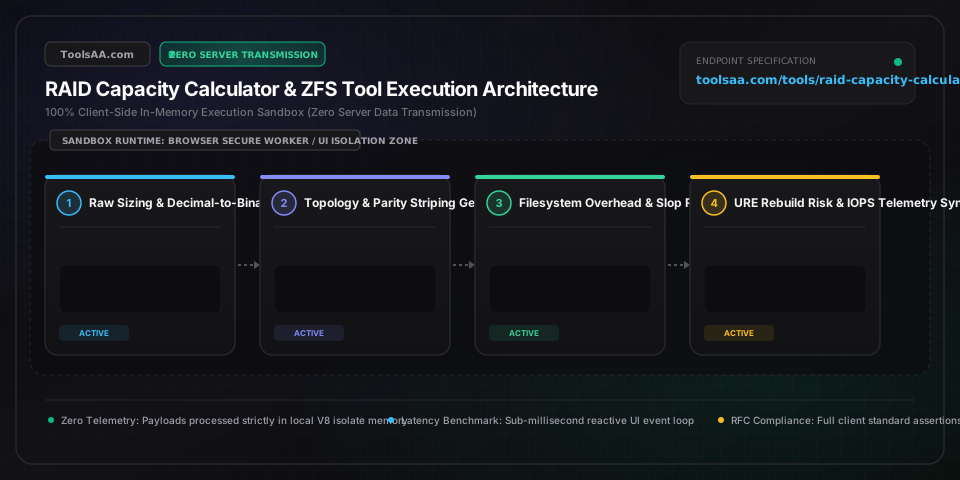
Guarantees all array calculations, Poisson rebuild survivability vectors, and parity geometries execute purely within the client WebAssembly/V8 sandbox with zero network telemetry or server-side transmission. Storage topology configurations, disk serial geometries, and datastore capacities remain isolated in local volatile memory in adherence to zero-trust architecture and cryptographic confidentiality.
Never exceed 80% pool allocation on Copy-on-Write (ZFS / Btrfs) storage pools. When pool capacity crosses the 80% threshold, the ZFS space allocator switches from an O(1) space map first-fit algorithm to an intensive best-fit search across metaslabs. This causes catastrophic filesystem fragmentation, destroying sequential write locality and plunging random write IOPS by up to 70%.
A single ZFS RAIDZ vdev delivers the random write IOPS performance of only ONE constituent drive, regardless of whether it spans 4 or 24 disks. Sizing a 24-bay chassis as a single 24-drive RAIDZ2 vdev cripples virtual machine datastores and database transaction log throughput. To scale IOPS linearly, stripe multiple narrower vdevs together (e.g. four 6-drive RAIDZ2 vdevs) or deploy mirrored vdevs (RAID 10 equivalent).
Always format modern 4Kn and 512e advanced format hard drives and SSDs with ashift=12 (4,096-byte sector alignment) when creating ZFS pools (`zpool create -o ashift=12`). Accepting the legacy default ashift=9 (512-byte sectors) causes 4KB native sectors to be split across multiple physical writes, triggering an unavoidable 300%+ write amplification penalty that degrades I/O performance and accelerates NAND endurance degradation.
Upgrading a storage pool from RAID 5 + Dedicated Hot Spare to an active RAID 6 array with identical drive counts provides exponentially superior survivability. A hot spare remains completely idle during steady state and offers zero redundancy during the high-stress rebuild window. Conversely, RAID 6 maintains active Reed-Solomon dual parity at all times, surviving a secondary drive failure or URE throughout reconstruction.
Root reserve allocation and partition metadata overhead consume raw blocks. Linux ext4 automatically reserves 5% of volume blocks for the root superuser to prevent total system deadlock; reclaim this on non-root storage mounts using 'tune2fs -m 1 /dev/sdX' to reduce the reserve to 1%. Furthermore, account for GPT EFI partition tables, LVM metadata extents (4-8 MiB), and ZFS 3.125% slop space ('spa_slop_shift=5') that reserves headroom for copy-on-write snapshot and file deletion operations.
Immediate secondary read failure during single-parity RAID 5 rebuild occurs when encountering unreadable sectors on surviving 8TB+ disks. Immediately halt write operations and create bit-level raw block clones of all surviving disks to alternate media using 'ddrescue -b 4096 /dev/sdX /media/recovery.img' before running fsck or reinitializing metadata. To eliminate this vulnerability in future arrays, mandate dual parity (RAID 6 or RAIDZ2) for any array containing disks >= 4TB to tolerate secondary sector read failures.
Resilvering contention arises from Shingled Magnetic Recording (SMR) drive drive-managed caching bottlenecks or metadata starvation in undersized Adaptive Replacement Cache (ARC). Verify using 'smartctl -i /dev/sdX' that drives are Conventional Magnetic Recording (CMR); replace any Host-Managed or Drive-Managed SMR drives immediately. To stabilize production workloads, throttle resilvering I/O priority via 'zfs set zfs:zfs_resilver_min_time_ms=2000' and expand host ARC memory to eliminate metadata cache evictions.
Usable RAID capacity is determined by array topology and parity disk overhead: RAID 0 provides N * Drive_Capacity (0% parity loss); RAID 1 provides 1 * Drive_Capacity (50% mirror loss on 2 drives); RAID 5 provides (N - 1) * Drive_Capacity; RAID 6 provides (N - 2) * Drive_Capacity; and RAID 10 provides (N / 2) * Drive_Capacity. For ZFS RAIDZ pools, subtract an additional 3.125% (1/32nd) pool slop space allocation and convert decimal terabytes to binary tebibytes using the 0.9095 factor (1 TiB = 10^12 / 2^40 TB).
Hard drive manufacturers market capacity using decimal notation where 1 Terabyte (TB) = 10^12 bytes, whereas operating systems address storage using binary Tebibytes (TiB) where 1 TiB = 2^40 = 1,099,511,627,776 bytes. This mathematical discrepancy creates an immediate 9.0949% apparent capacity reduction (e.g., an 18 TB drive yields only ~16.37 TiB of raw space). Partition table metadata (GPT EFI), filesystem allocation tables (inode tables, journaling extents), and ZFS slop space reservation further reduce final usable capacity.
RAID 5 provides single-drive fault tolerance, requiring every surviving disk to be read completely to recalculate parity during a rebuild. Standard consumer SATA drives specify an Unrecoverable Read Error (URE) rate of 10^-14 (1 bit error per 12.5 TB read). Rebuilding a 4-drive 16TB array requires reading 48 TB of continuous data, generating a statistical rebuild failure probability exceeding 98% via Poisson modeling P = 1 - exp(-Bits * BER), causing complete array destruction upon encountering a single unreadable sector.
RAID 10 stripes across mirrored pairs with a write penalty factor of 2, whereas RAID 6 computes dual P+Q Reed-Solomon parity with a write penalty factor of 6. For high-transaction transactional databases (MySQL, PostgreSQL, Oracle) with heavy random write I/O, RAID 10 delivers 300% higher random write IOPS and re-mirrors degraded drives without parity recalculation strain. RAID 6 is optimized for sequential read-heavy throughput, backup repositories, and cost-effective bulk archival storage.
ZFS RAIDZ2 replaces fixed stripe sizes and hardware battery-backed cache controllers (BBU) with dynamic stripe widths and 128-bit Fletcher4/SHA-256 cryptographic checksums, completely eliminating the catastrophic RAID 5/6 'write hole'. During reconstruction (resilvering), ZFS only reads and recalculates actual live metadata and active data blocks rather than scanning empty unallocated sectors, and automatically detects and repairs silent data corruption (bit rot) during scheduled scrub cycles.
The ZFS 80% rule dictates that storage pools should not exceed 80% capacity utilization to avoid transitioning from an O(1) space map first-fit allocator to a high-latency best-fit search that triggers severe fragmentation and IOPS degradation. OpenZFS concurrently enforces a default slop space reservation of 3.125% (1/32nd of total raw pool capacity, minimum 128 MiB) governed by 'spa_slop_shift=5', ensuring administrative operations like snapshot removal, filesystem destruction, and metadata writes succeed when a pool reaches 100% user quota.
Rebuild duration is determined by raw drive capacity, sustained sequential write bandwidth, controller backplane throughput, and concurrent application I/O load. Under zero background workload, an enterprise 18TB 7,200 RPM drive sustaining 200 MB/s takes approximately 25 to 30 hours to rebuild. Under 50% production transactional workload or when deployed with Shingled Magnetic Recording (SMR) drives, rebuild duration expands to 5 to 9 days, substantially enlarging the vulnerability window for secondary hardware failures.
Calculate exact A/B test sample size, statistical power, and test duration. Features MDE reverse solving, continuous metrics, multi-armed Bonferroni, and SRM.
Convert PX to REM and REM to PX instantly with custom root font sizes. Generate clean CSS clamp() fluid typography, Tailwind classes, and conversion tables.
Check HTTP status codes, test redirect chains, and inspect response headers. Diagnose 1xx to 5xx error codes, RFC specifications, SEO impact, and fixes.
Test, debug, and optimize regular expressions in real time. Inspect regex pattern matches, capture groups, step-by-step token explanations, and replace syntax.
Calculate IPv4 subnet masks, CIDR network ranges, usable host addresses, and broadcast IPs. Features bitwise binary inspection, VLSM planning, and cloud VPC rules.
Calculate binary addition and subtraction with step-by-step carry bits, two's complement signed values, bitwise logic gates, and hex conversion in real time.