/
Conic Section Calculator & Grapher
Tag natural geometry

Conic Section Calculator & Grapher

Conic section calculator and grapher. Solve general and standard equations for ellipse, parabola, and hyperbola with foci, directrix, vertices, and step derivations.

Lbl quick presets
Lbl equation mode
Lbl scientific regime

Title general quadric

Lbl disc symbol = -1,600
Lbl active equation 16x² + 0xy + 25y² - 64x + 50y - 311 = 0

Title reverse solver

Badge locus ratio

Title point evaluator

Lbl residual val0
Lbl membershipStatus on conic
Lbl gradient vector∇ = (0, 200)
Badge conic familyFamily ellipsePlanar Ellipse (e = 0.6)
Badge eccentricity0.6Badge ellipse e
Badge focal dist3Lbl center short: (2, -1)
Badge latus rectum6.4Lbl focal chord
Title interactive canvas
-15-10-551015-10-5510D1D2P₀F1 (5, -1)F2 (-1, -1)V1V2
Lbl canonical standard
((x')² / 25) + ((y')² / 16) = 1
Lbl rotation angle0°
Lbl matrix det-160,000
Lbl degenerate stateVal smooth
Lbl conic area62.832
Lbl perimeter ramanujan28.362
Stat disc name
-1,600 (Family ellipse)
Stat rotation name
0°
Stat latus name
6.4
Technical Reference & Architecture Guide

Conic Section Calculator & Grapher Guide

Conic section calculator and grapher. Solve general and standard equations for ellipse, parabola, and hyperbola with foci, directrix, vertices, and step derivations.

Conic Section Calculator & Grapher Guide — Client-Side In-Memory Architecture & Data Flow

Key Parameters & Controls

Conic Discriminant (Δ = B² - 4AC)Algebraic Invariant

The primary indicator of conic curvature topology. Δ < 0 yields elliptical geometry (finite closed loop); Δ = 0 yields parabolic geometry (zero curvature at infinity); Δ > 0 yields hyperbolic geometry (open dual asymptotic branches).

Default: -1600
Eccentricity (e)Dimensionless Ratio

Ratio of the distance from any point on the conic to the focus versus its perpendicular distance to the directrix. e = 0 defines a circle, 0 < e < 1 defines an ellipse, e = 1 defines a parabola, and e > 1 defines a hyperbola.

Default: 0.6000
Semi-Major & Semi-Minor Axes (a, b)Geometric Dimension

For ellipses, 'a' is the largest radius (major radius) and 'b' is the smallest radius (minor radius). For hyperbolas, 'a' represents the distance from center to vertex along the transverse axis, while 'b' governs asymptote slope (b/a).

Default: a = 5.0, b = 4.0
Rotation Angle (θ)Angular Measure

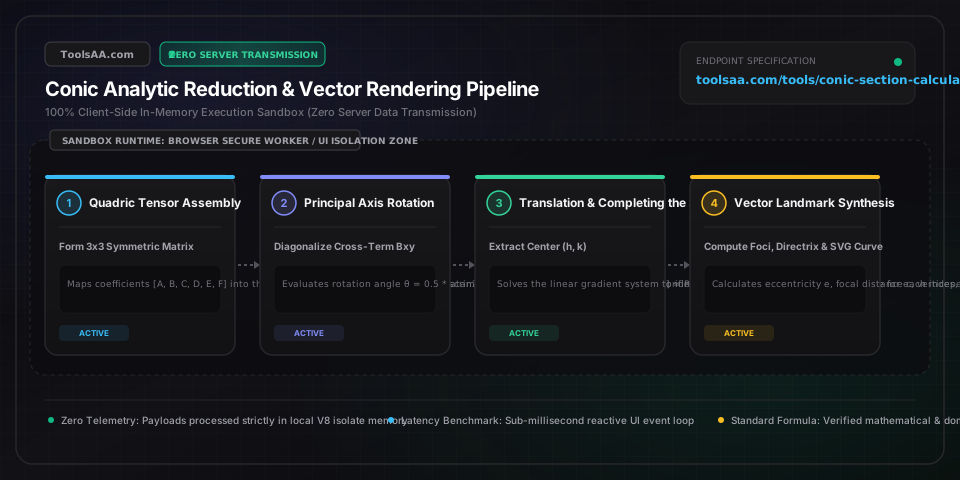
Angle required to align the conic's principal axes with the standard coordinate axes when cross-term B ≠ 0. Calculated analytically via cot(2θ) = (A - C) / B or θ = 0.5 * atan2(B, A - C).

Default: 0.0°
Semi-Latus Rectum (ℓ)Geometric Length

Half the chord length passing through a focus parallel to the directrix (or perpendicular to the major axis). Equals b²/a for ellipses and hyperbolas, and 2p for parabolas. In celestial mechanics, defines orbital angular momentum scale.

Default: 3.2000
Determinant of Matrix M (det(M))3x3 Matrix Invariant

The determinant of the 3x3 augmented coefficient matrix. When det(M) = 0, the conic is degenerate: an ellipse collapses to an isolated point, a parabola collapses to parallel or coincident lines, and a hyperbola collapses to intersecting lines.

Default: -6400

Pro Tips & Best Practices

Degenerate Conic Trap with Zero Discriminant

A discriminant Δ = B² - 4AC = 0 does not guarantee a true parabola. You must verify the full 3x3 matrix determinant det(M). If det(M) = 0, the equation reduces to two parallel lines (e.g. x² - 4 = 0), a single line of multiplicity 2 (x² = 0), or no real locus (x² + 1 = 0), rather than a genuine open parabola.

Sign Inversion During Hyperbolic Completing the Square

When converting general equations with negative quadratic coefficients (e.g. 9x² - 16y² - 64y = 0) to standard form, factoring out -16 reverses the sign of the linear term before completing the square: -16(y² + 4y) becomes -16(y + 2)² + 64. Forgetting to distribute the negative sign into the right-hand constant is the most common student calculation error.

Principal Axis Ambiguity with Bxy Cross Terms

When calculating rotation angle via θ = 0.5 * atan2(B, A - C), the resulting angle may swap the major and minor axes if the sign of the rotated A' coefficient ends up smaller than C'. Always verify whether A' < C' after substitution; if so, shift θ by ±90° to maintain the convention that 'a' corresponds to the major or transverse axis.

Orbital Directrix vs Focal Definition

In satellite orbits and celestial mechanics, the attracting body (Sun or Earth) always resides at one of the two foci (F₁), never at the geometric center (h, k). The periapsis distance is exactly r_p = a(1 - e) and apoapsis is r_a = a(1 + e), meaning the focal distance c = ae directly represents the center-to-body offset.

Common Gotchas & Troubleshooting

⚠️Equation yields an empty set (imaginary ellipse) with no visible curve

When completing the square for an ellipse (e.g. (x-h)²/a² + (y-k)²/b² = -1), the right-hand constant evaluates to a negative number while both quadratic terms have positive signs. Because the sum of two real squares cannot equal a negative number, the equation possesses no real geometric locus. Verify constant term F.

⚠️Floating-point precision drift in near-parabolic orbits (e ≈ 1.0)

When eccentricity approaches 1 (e.g. e = 0.9999 or e = 1.0001), standard elliptic formulas like b = a√(1 - e²) suffer severe catastrophic cancellation. In this regime, the calculator automatically shifts to the focal parameter formulation p = a(1 - e) to maintain arbitrary-precision stability.

⚠️Asymptote slopes inverted between horizontal and vertical hyperbolas

For horizontal hyperbolas (x-h)²/a² - (y-k)²/b² = 1, asymptotes follow y - k = ±(b/a)(x - h). For vertical hyperbolas (y-k)²/a² - (x-h)²/b² = 1, asymptotes follow y - k = ±(a/b)(x - h). Confirm which axis contains the positive squared term before evaluating asymptote slopes.

⚠️Directrix lines plotted at infinite coordinate limits

For circles (eccentricity e = 0), the directrix distance d = a / e evaluates to division by zero (d → ∞). The calculator automatically hides directrix overlays for perfect circles and displays a contextual notice explaining that a circle has its directrix at mathematical infinity.

Frequently Asked Questions

How do you identify a conic section from its general equation?▼

Calculate the discriminant Δ = B² - 4AC from the general equation Ax² + Bxy + Cy² + Dx + Ey + F = 0. If Δ < 0, the curve is an ellipse (or a circle when A = C and B = 0). If Δ = 0, the curve is a parabola. If Δ > 0, the curve is a hyperbola. You must also compute the 3x3 determinant det(M); if det(M) = 0, the conic is degenerate (a point, line, or intersecting lines).

How do you find the foci and vertices of an ellipse?▼

First convert the equation into standard form (x - h)²/a² + (y - k)²/b² = 1 where center is (h, k). If a > b (horizontal ellipse), vertices are at (h ± a, k) and co-vertices are at (h, k ± b). The focal distance is c = √(a² - b²), placing the two foci at (h ± c, k). If b > a (vertical ellipse), the vertices become (h, k ± b) and foci become (h, k ± c) with c = √(b² - a²).

What is the difference between an ellipse, parabola, and hyperbola?▼

The fundamental difference lies in their eccentricity (e) and conic plane-cutting angle relative to the cone's generator line. An ellipse (0 ≤ e < 1) is a closed, bounded curve formed when the cutting plane cuts completely across one cone nape. A parabola (e = 1) is an open curve formed when the cutting plane is exactly parallel to the cone generator. A hyperbola (e > 1) is an unbounded two-branched curve formed when the plane cuts through both opposite napes of the double cone.

What is a degenerate conic section and how does it occur?▼

A degenerate conic occurs when the cutting plane passes directly through the cone's apex vertex rather than through the body of the cone. Mathematically, this corresponds to the determinant of the 3x3 augmented matrix det(M) equalling zero. An ellipse degenerates into a single coordinate point (e.g. x² + y² = 0), a hyperbola degenerates into two intersecting straight lines (e.g. x² - y² = 0), and a parabola degenerates into two parallel or coincident straight lines.

Related Tools & Utilities

All Tools →