Short title

SaaS Tax Calculator (Sales Tax & VAT)

Calculate SaaS sales tax, EU VAT OSS, and state economic nexus thresholds instantly. Estimate software subscription tax liabilities and net MRR/ARR margins.

Lbl load sample
Sec core revenue
Lbl mrr: $41,667
$
85% Lbl b2b abbr / 15% Lbl b2c abbr

Lbl b2b help

$
Lbl acv help
417
Gauge metric txn
65%
30%

Lbl section174 notice

Sec b2b exemption85% Lbl exemption rate
Lbl tax shield value$32,241
Lbl audit protection index98.5%
Kpi total tax liability$8,1341.63% Kpi effective tax rate
Kpi net retained revenue$500,000100.0% Stat estimated net yield
Kpi nexus risk status
1 - Gauge status warning
New York (75%)
Gauge nexus title75.0%
New YorkGauge status warning
Chart waterfall titleChart cit buffer: $105,800
Yield40%
Chart net cash flow$202,200
Lbl operating margin$175,000
Chart indirect tax-$8,134
Badge sec174-$31,050
Chart processing fees-$17,000
10 / 10
Col jurisdictionCol tax typeCol standard rateCol taxability saa sCol revenue allocatedCol est tax liabilityCol effective yield
CaliforniaSales & Use Tax8.85%0%$140,000$0100.0%
New YorkState & Local Sales Tax8.52%100%$90,000$2,454100.0%
TexasSales Tax (Data Processing)8.20%80%$75,000$1,574100.0%
WashingtonRetail Sales Tax / B&O9.38%100%$40,000$1,201100.0%
PennsylvaniaSales Tax6.34%100%$35,000$710100.0%
MassachusettsSales Tax6.25%100%$30,000$600100.0%
Illinois / ChicagoSales & Lease Tax6.25%100%$30,000$600100.0%
ColoradoState & Home-Rule Tax7.81%100%$25,000$625100.0%
OhioSales & Use Tax7.24%80%$20,000$371100.0%
FloridaCommunications / Sales7.02%0%$15,000$0100.0%
Stat total jurisdictions (10)$500,000$8,134100.0%
Stat total jurisdictions10
Stat breached nexus count0
Stat estimated net yield100.0%
Disclaimer title

Disclaimer text

Technical Reference & Architecture Guide

SaaS Tax Calculator (Sales Tax & VAT) Guide

Calculate SaaS sales tax, EU VAT OSS, and state economic nexus thresholds instantly. Estimate software subscription tax liabilities and net MRR/ARR margins.

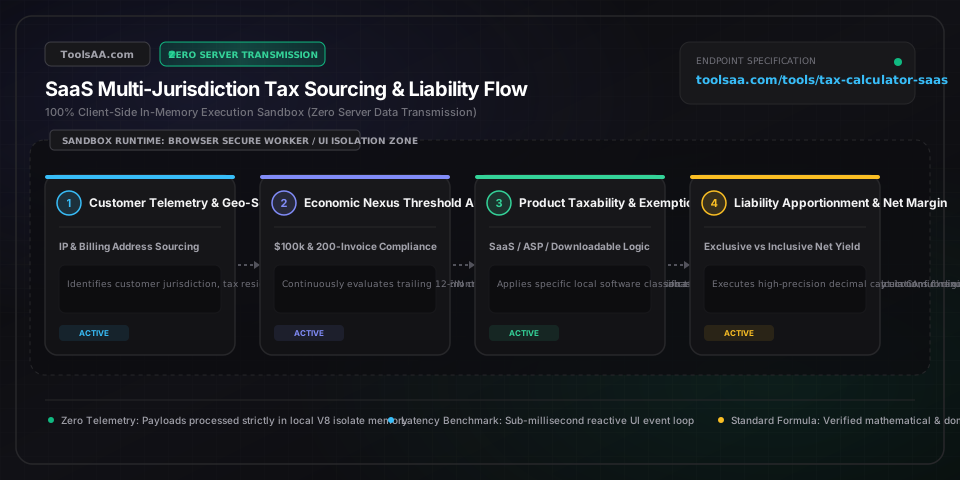
SaaS Tax Calculator (Sales Tax & VAT) Guide — Client-Side In-Memory Architecture & Data Flow

Key Parameters & Controls

Annual Recurring Revenue (ARR)Contracted Annualized Revenue

The normalized annual run-rate of recurring subscription revenue. Serves as the primary gross metric for evaluating single-state economic nexus statutory caps (typically $100,000 in 40+ states, or $250,000 to $500,000 in California and Texas).

Default: $500,000
B2B Reverse-Charge ProportionExempt Customer Allocation Ratio

Percentage of subscription revenue derived from registered corporate entities providing valid tax IDs (e.g. EU VAT VIES, federal EIN/resale certificates). Qualified B2B transactions trigger reverse-charge mechanisms, shifting indirect remittance away from the seller.

Default: 75%
Economic Nexus Transaction CountAnnual Invoice Volume

Total separate sales transactions delivered into a specific jurisdiction. Approximately 15 US states enforce a statutory cliff of 200 distinct sales invoices, which can inadvertently trigger nexus for micro-ticket B2C apps well before reaching $100,000 revenue.

Default: 416 transactions
Pricing Structure ModeTax Allocation Model

Determines whether sales tax/VAT is calculated on top of the list price (Tax-Exclusive, standard in North American B2B SaaS) or included within the flat sticker price (Tax-Inclusive, mandatory for European B2C commerce), directly impacting realized gross margin.

Default: Tax-Exclusive
Section 174 R&D Expense RatioSoftware Engineering Capitalization

Percentage of total annual operating expenses allocated to domestic software engineering and direct product development. Under IRS Section 174 rules, domestic R&D must be amortized over 5 years (foreign over 15 years), inflating taxable net corporate income.

Default: 30%

Pro Tips & Best Practices

Beware the 200-Transaction Cliff for Low-ACV Products

If your SaaS sells a $10/month subscription ($120/year), just 17 active annual subscribers in states like Illinois, Utah, or North Carolina can generate over 200 separate monthly billing invoices, triggering full state sales tax registration requirements on less than $2,500 of annual revenue.

SaaS Taxability Discrepancy Across Major US States

SaaS is NOT universally taxable in the US: California completely exempts pure cloud-hosted SaaS (software accessed via browser with no downloadable agent), whereas New York taxes SaaS as tangible personal property, and Texas taxes SaaS at 80% of value (offering a mandatory 20% statutory exemption).

Tax-Inclusive Pricing Silently Erodes Gross Margins by Up to 21%

Selling a flat $99/month subscription globally with tax-inclusive billing means a customer in Hungary (27% VAT) yields only $77.95 net recurring revenue, whereas an identical subscriber in Delaware (0% sales tax) yields the full $99.00. Always isolate tax-inclusive prices per sovereign region.

VIES Validation Failure Converts B2B Zero-Rating into Full Liability

In the European Union, simply asking for a corporate company name does not satisfy statutory reverse-charge audits. Unless you query and store the real-time EU VIES digital validation token alongside the customer's country-matched IP/billing address, tax authorities will hold your SaaS liable for retroactive local B2C VAT.

Common Gotchas & Troubleshooting

⚠️Economic nexus flagged as triggered in California despite exceeding $500,000 ARR

California's $500,000 threshold applies to tangible personal property sales; however, under California CDTFA Regulation 1502, pure remotely hosted software with no local client downloads or hardware transfer is classified as an untaxable service. Verify whether your software delivers downloadable executables before registering.

⚠️Corporate net income tax liability is positive despite financial cash-flow break-even

Under the US Tax Cuts and Jobs Act (TCJA) Section 174 mandates, software development wages can no longer be expensed immediately in Year 1. They must be amortized over 5 years straight-line (with a mid-year convention allowing only 10% deduction in Year 1), creating statutory phantom taxable income.

⚠️European B2B customers demanding VAT-exempt refunds after automatic billing

Configure automated reverse-charge billing capture prior to credit card authorization. If an existing subscriber inputs their valid intra-community VAT ID retroactively, issue a formal credit note referencing Article 196 of the EU VAT Directive and recalculate the net receivable.

Frequently Asked Questions

How do you calculate SaaS sales tax on software subscriptions?▼

SaaS sales tax is calculated using destination sourcing: multiply the taxable subscription billing amount by the combined state, county, and municipal tax rate of the customer's primary benefit location (Billing Amount × Combined Local Tax Rate). For tax-inclusive pricing, reverse-calculate using: Net SaaS Revenue = Total Billed / (1 + Combined Tax Rate).

When does a SaaS company trigger economic nexus in the United States?▼

A SaaS business triggers economic nexus when its sales into a single state exceed statutory thresholds established post-South Dakota v. Wayfair, most commonly $100,000 in gross annual revenue or 200 distinct billing transactions over the preceding or current calendar year, though thresholds range up to $500,000 in states like California and Texas.

What is the difference between B2B reverse charge and B2C sales tax for SaaS?▼

In B2B transactions with validated tax identification, the reverse-charge mechanism shifts the indirect tax reporting obligation to the commercial buyer (resulting in 0% tax added at checkout), whereas B2C transactions require the SaaS seller to collect, remit, and file local consumer destination VAT/sales tax (ranging from 5% to 27%) directly with the buyer's sovereign tax agency.

Does tax-inclusive pricing reduce SaaS gross margins?▼

Disclaimer: This tool is provided strictly for educational and informational purposes only and does not constitute formal financial advice or a binding loan commitment. Please consult a qualified financial advisor before making decisions. Yes, tax-inclusive pricing reduces SaaS gross margins because indirect tax liabilities are absorbed directly from the top-line subscription price; for example, a fixed $100 monthly subscription sold into a 20% VAT country yields exactly $83.33 in recognized net revenue, compressing operating margins by $16.67 per subscriber compared to tax-exclusive billing.

Related Tools & Utilities

All Tools →