Title Case Converter & Headline Capitalizer

Title Case Converter & Headline Capitalizer

Convert headlines and titles to APA, Chicago, MLA, AP, and NYT title case instantly. Features SERP pixel preview, hyphenated compound rules, and brand preservation.

Sec quick stats
Lbl input title
web3TypeScript
Lbl output title
The Impact of AI and Machine Learning on Modern Cognitive Psychology: A Meta-Analysis of Pre-existing Studies
Lbl click to toggle
Lbl serp simulator
580Unit px911.9Unit pxLbl serp cutoff warning shortLbl lexical spectrumLbl pos noun (9)Lbl pos preposition (3)Lbl pos article (2)Lbl pos verb (0)Lbl pos brand (1)
G
https://toolsaa.com›Category title
The Impact of AI and Machine Learning on Modern Cognitive Psychology: A Meta-Analysis of Pre-existing Studies

Disclaimer text

Stat chars109
Stat words16
Stat serp pixels911.9px
Stat tokens changed12
Technical Reference & Architecture Guide

Title Case Converter & Headline Capitalizer Guide

Convert headlines and titles to APA, Chicago, MLA, AP, and NYT title case instantly. Features SERP pixel preview, hyphenated compound rules, and brand preservation.

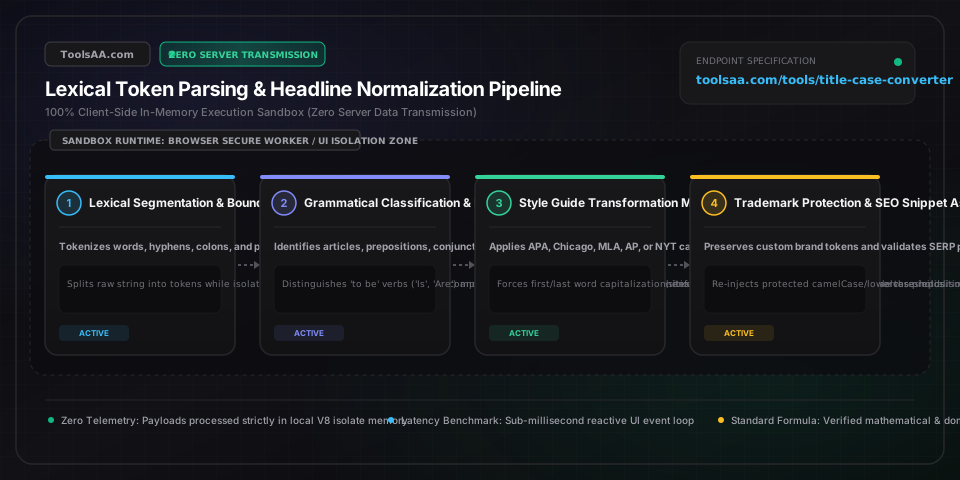
Title Case Converter & Headline Capitalizer Guide — Client-Side In-Memory Architecture & Data Flow

Key Parameters & Controls

Style Guide Editorial Standard (APA vs Chicago vs MLA vs AP vs NYT)Editorial Standard

The governing typographical specification. APA and MLA lowercase prepositions irrespective of length (MLA) or under 4 letters (APA); Chicago lowercases all prepositions regardless of length (e.g., 'between', 'through'); AP capitalizes all words with 4 or more letters regardless of grammatical classification.

Default: APA 7th Edition
Subtitle Capitalization Trigger (: / - / ? / !)Boundary Demarcation Rule

Capitalizes the first word immediately following terminal punctuation (colons, em-dashes, question marks). Mandated universally across APA 7th §2.18, Chicago §8.159, and MLA §1.2 for primary-to-secondary headline boundaries.

Default: Enabled (Universal Standard)
Hyphenated Compound Second-Element CapitalizationMorphological Orthography Rule

Governs whether the second element in hyphenated terms (e.g. 'Pre-existing', 'Self-Driving', 'Step-by-Step') is capitalized. Chicago and APA capitalize the second word if it is a major word or equal in weight; coordinate prefixes ('Anti-intellectual') keep the second word lowercase in AP unless it is a proper noun.

Default: Style Guide Compliant
Acronym & CamelCase Brand Preservation WhitelistLexical Token Exception Whitelist

Protects registered trademarks, casing-sensitive technical tokens, and initialisms (e.g., 'iOS', 'eBay', 'GraphQL', 'mRNA', 'pH', 'LLMs') from destructive title-casing conversions.

Default: Auto-detect Common Tech & Science Brands
Small Word Exclusion Threshold (Letter Count)Grammatical Length Cutoff Criterion

Word length cutoff for automatic lowercasing of minor grammatical particles. AP Style strictly enforces a 3-letter threshold (capitalizing 'With', 'From', 'Over', 'Into'); APA enforces a 3-letter threshold for prepositions and conjunctions; Chicago lowercases prepositions of any length (including 'throughout', 'underneath').

Default: 3 letters (AP/APA) / Infinite for prepositions (Chicago)

Pro Tips & Best Practices

Prepositions of Four or More Letters Split AP and Chicago Rules

AP Style mandates capitalizing any word with 4 or more letters—including prepositions like 'With', 'From', 'Into', and 'Over'. In contrast, the Chicago Manual of Style (CMOS 8.159) mandates lowercasing ALL prepositions regardless of length ('with', 'from', 'into', 'throughout', 'underneath'). If submitting book manuscripts to university presses, ensuring 5+ letter prepositions remain lowercase is the #1 caught error by copyeditors.

Phrasal Verbs vs Prepositional Phrases in Title Casing

When a short word acts as an adverbial particle in a two-word phrasal verb (e.g., 'Shut Down', 'Log In', 'Back Up', 'Sign Off'), it MUST be capitalized in all style guides including APA and Chicago because it functions as part of the verb predicate, not a relational preposition. However, when acting as a pure preposition ('stepping down from the podium', 'logged into the server'), it follows lowercasing rules.

The Subtitle Rule Always Overrides Minor Word Lowercasing

Even if a word is an article ('a', 'an', 'the') or a short conjunction ('and', 'but'), it MUST be capitalized if it immediately follows a colon, em-dash, or question mark marking a subtitle (e.g. 'Quantum Supremacy: The Architecture of Next-Gen Computing', NOT 'Quantum Supremacy: the Architecture'). All major style guides (APA 7th §2.18, Chicago §8.159, MLA §1.2) strictly enforce this position-based override.

Hyphenated Affixes vs Compound Words

Do not capitalize the second element in hyphenated words if it is a simple grammatical suffix or prefix attachment to a root word without independent semantic weight (e.g. 'Anti-inflammatory', 'Re-evaluate', 'Co-author' in AP and Chicago), but ALWAYS capitalize the second element when both parts form an equal compound noun or adjective (e.g. 'High-Tech', 'Cost-Benefit Analysis', 'Cross-Platform').

Common Gotchas & Troubleshooting

⚠️Short verb 'Is' or 'Be' mistakenly converted to lowercase

'Is', 'Are', 'Was', and 'Be' are forms of the verb 'to be'. Style rules that lowercase 2-letter or 3-letter words only apply to articles, prepositions, and coordinating conjunctions. Verbs are ALWAYS capitalized regardless of length in APA, Chicago, MLA, and AP. The converter explicitly tags 'to be' auxiliary verbs as major grammatical elements.

⚠️Tech brands with lowercase initial prefixes like 'iPhone', 'eBay', or 'mRNA' get ruined into 'Iphone' or 'Ebay'

Enable the 'Brand & Trademark Preservation' toggle or add the token to the Custom Exception Whitelist. Both Chicago (§8.154) and AP Style recognize that proprietary trademarks and scientific nomenclature (e.g., 'pH', 'macOS', 'dd/mm/yyyy') retain their established camelCase or lowercase-prefix orthography even at the beginning of titles or after colons.

⚠️Colons inside URLs, timestamps, or scripture citations mistakenly trigger subtitle capitalization

The parser distinguishes between rhetorical subtitle colons (followed by a whitespace and lexical word) versus inline syntactic colons (such as 'v1:2' in bible verses, '10:30 AM' in times, or 'https://' in URLs) by inspecting trailing boundaries and alphanumeric lookahead, preventing spurious title capitalization mid-token.

Frequently Asked Questions

What words should not be capitalized in title case?▼

In standard title case (APA, Chicago, MLA), you should not capitalize articles ('a', 'an', 'the'), coordinating conjunctions ('and', 'but', 'for', 'nor', 'or', 'so', 'yet'), and short prepositions ('as', 'at', 'by', 'for', 'in', 'of', 'off', 'on', 'per', 'to', 'up', 'via') unless they are the first or last word of the title or subtitle. However, AP Style requires capitalizing ANY word with 4 or more letters (e.g., 'From', 'With', 'Over'), while Chicago lowercases all prepositions regardless of length.

Is 'with' capitalized in title case?▼

It depends on the style guide: in AP Style, 'With' is always capitalized because it contains 4 letters; in Chicago Manual of Style, 'with' is always lowercase because it is a preposition; in APA 7th Edition, words with 4 or more letters are capitalized, so 'With' is capitalized; in MLA 9th, all prepositions are lowercase regardless of length, so 'with' remains lowercase.

What is the difference between APA and Chicago title case?▼

The primary difference lies in preposition length and hyphenated compounds: Chicago Manual of Style lowercases ALL prepositions regardless of character count (e.g. 'through', 'between', 'against', 'among'), whereas APA 7th Edition only lowercases prepositions and conjunctions that are 3 letters or fewer, meaning APA capitalizes 4-letter prepositions ('With', 'From', 'Into', 'Over'). Additionally, Chicago provides nuanced hyphenation rules based on parts of speech, while APA capitalizes both elements of a hyphenated compound if either is 4+ letters.

Do you capitalize the word after a colon in a title?▼

Yes, in APA, Chicago, and MLA style guides, you must always capitalize the first word following a colon, question mark, or em-dash, as it introduces the subtitle. For example: 'Machine Learning: A Practical Approach' (capitalizing 'A' despite it being a single-letter article). The only exception is British/Oxford style or certain European conventions where lowercase subtitles are retained if the clause cannot stand as an independent sentence.

How does title case handle hyphenated words?▼

Under Chicago and APA rules, you always capitalize the first element, and you capitalize the second element if it is a noun, pronoun, adjective, or verb, or if it has equal weight (e.g., 'Peer-to-Peer', 'Self-Driving Cars'). You do not capitalize the second element if it is a lowercase particle/preposition ('Step-by-Step', 'Run-of-the-Mill') or a modifying prefix attached to an uncapitalized common stem ('Pre-election', 'Co-author').
Related Tools & Utilities

All Tools →